Sacred Scripture — Comprehensive Viva Study Pack
B.Th. Comprehensive Oral Viva 2025–26 · Questions 1–22
How to use this section: Each question is answered from your own class notes. Big themes get a full treatment with tables; small or factual questions get a short answer or a single table. Look for In short (the one-line essence to say first), the tables (for fast revision), Connections (links to other subjects — useful for follow-up questions), and [supplemented] marks (added from standard teaching where the notes were thin — please confirm these with your professors).
Q1 — Divine Revelation written in Sacred Scripture: rule of life preserved/interpreted/handed on by the Church, transmitted through Patriarchs–Prophets–Apostles, formed over a long process, a rich library of many genres and “authors” yet one unified story of salvation from Genesis to Revelation, culminating in Jesus and consummated at the end of time
In short: Sacred Scripture is the written record of God’s self-revelation — a self-revelation that began with creation, unfolded in deeds-and-words through the Patriarchs, Prophets and Apostles, reached its summit in Jesus Christ the Word-made-flesh, and is consummated at the end of time. The Bible is therefore not one book dropped from heaven but a whole library (Greek ta biblia = “the books”), 73 books in many literary forms by hundreds of human “authors” over roughly a thousand years, yet held in unity because one Author (the Holy Spirit) and one centre (Christ) run through it all. The Church — which is older than the Bible — preserves, interprets and hands it on as the rule of faith and life for every generation.
1. Revelation: God making known the hidden, in deeds and words
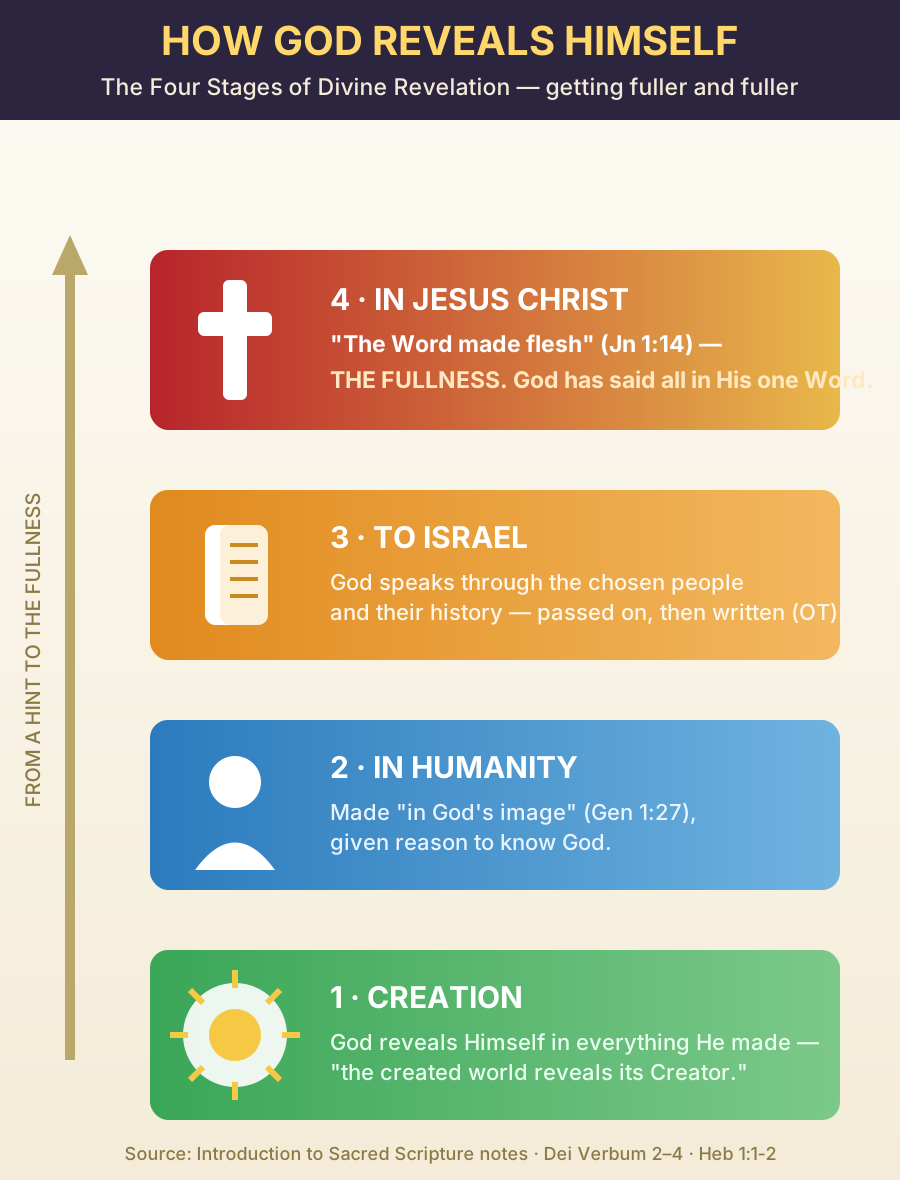
“Revelation is an act of making known something hidden.” God reveals Himself “gradually and in stages in words and in deeds” (the key Vatican-II formula from Dei Verbum 2 — deeds and words intrinsically bound together, the deeds carrying the mystery, the words clarifying it). The notes name four historical stages of this self-revelation:
| Stage | God reveals Himself… |
|---|---|
| 1. Creation (Natural Revelation) | in everything that exists — “the created world reveals its Creator”; the very first revelation, made by the Word |
| 2. In and to humanity | made “in God’s image” (Gen 1:26-27), endowed with reason to know God |
| 3. Special revelation to Israel | the chosen people, through their history; passed down orally, then written (the OT) |
| 4. In Jesus Christ | “the Word made flesh” (Jn 1:14) — the fullness: “In Jesus Christ, God has said all that needs to be said. He has spoken His one, perfect, unsurpassable Word” |
Sacred Scripture is “the written record of God’s revelation of Himself.” Revelation is wider than the Bible — God still reveals through nature, people, the liturgy — but Scripture contains its indispensable core: all the truths necessary for salvation, such that no later revelation can ever change or contradict it.
2. Scripture as the rule of life for all generations
The Bible “stands as the support and energy of the Church, the strength of faith for her sons, the food of the soul, the pure and everlasting source of spiritual life” (DV 2). St Paul: it is useful “for teaching, for refutation, for correction, and for training in righteousness” (2 Tim 3:16); the Word of God is “living and active, sharper than any two-edged sword” (Heb 4:12). It is Word of eternal life (Jn 6:68), lamp to my feet and light to my path (Ps 119:105), bread of life (Dt 8:3; Mt 4:4) — the guidebook for living, teaching and defending the faith. DV 21 sets the veneration of the Word in parallel with the Eucharist — both are the table from which the Church is fed.
3. Transmitted through Patriarchs, Prophets and Apostles — the chain of traditio
Revelation is “handed down” (Latin traditio) through the ages by the same stages in both the OT and NT eras:
| Step | OT era | NT era |
|---|---|---|
| 1. Historical Events | acts of patriarchs, prophets, kings, all Israel | acts of Jesus, his disciples and apostles |
| 2. Oral Traditions | stories and teachings passed on, often by anonymous people | the Good News alive in the community before any writing |
| 3. Written Documents | books of Moses, the prophets, the teachers | Gospels, letters, other early-Christian writings |
| 4. Canonization & Interpretation | — | the Church collects, “canonizes”, and goes on interpreting and applying in every century |
So the Word travelled: from the Patriarchs (Abraham, Isaac, Jacob), through Moses and the Prophets, to the Apostles who “learned it from the lips of Christ” or “at the prompting of the Holy Spirit” (DV 7). DV 8: “What was handed on by the apostles comprises everything that serves to make the people of God live their lives in holiness… the Church… perpetuates and transmits to every generation all that she herself is, all that she believes.”
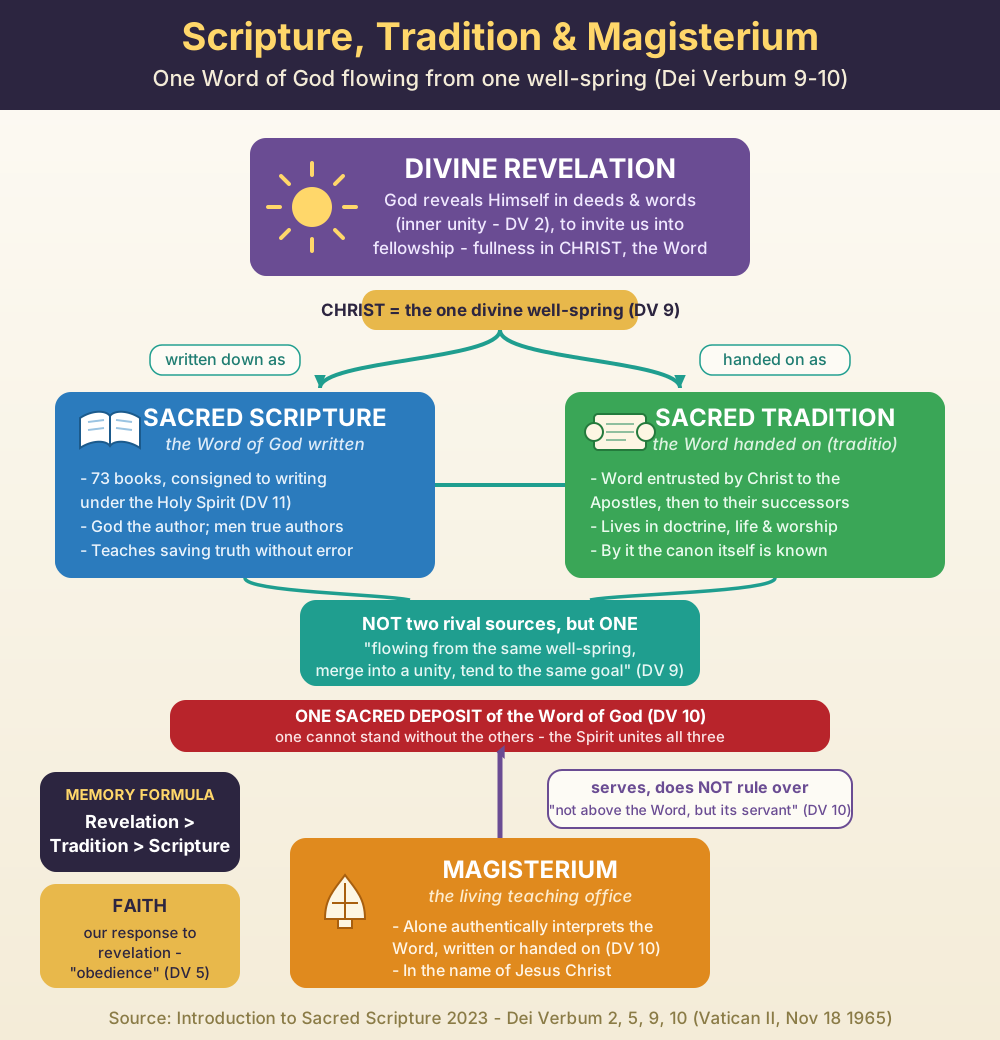
Scripture and Tradition are not two rival sources. DV 9 avoids the “two-source theory”: both “flow out from the same divine well-spring (scaturigo)… and move towards the same goal” — and that well-spring is Christ Himself. The relation is best expressed: Revelation > Tradition > Scripture (Scripture is part of Tradition, which is part of God’s self-revelation). And the living teaching office (Magisterium, DV 10) authentically interprets the Word — yet “is not superior to the Word of God, but is its servant.”
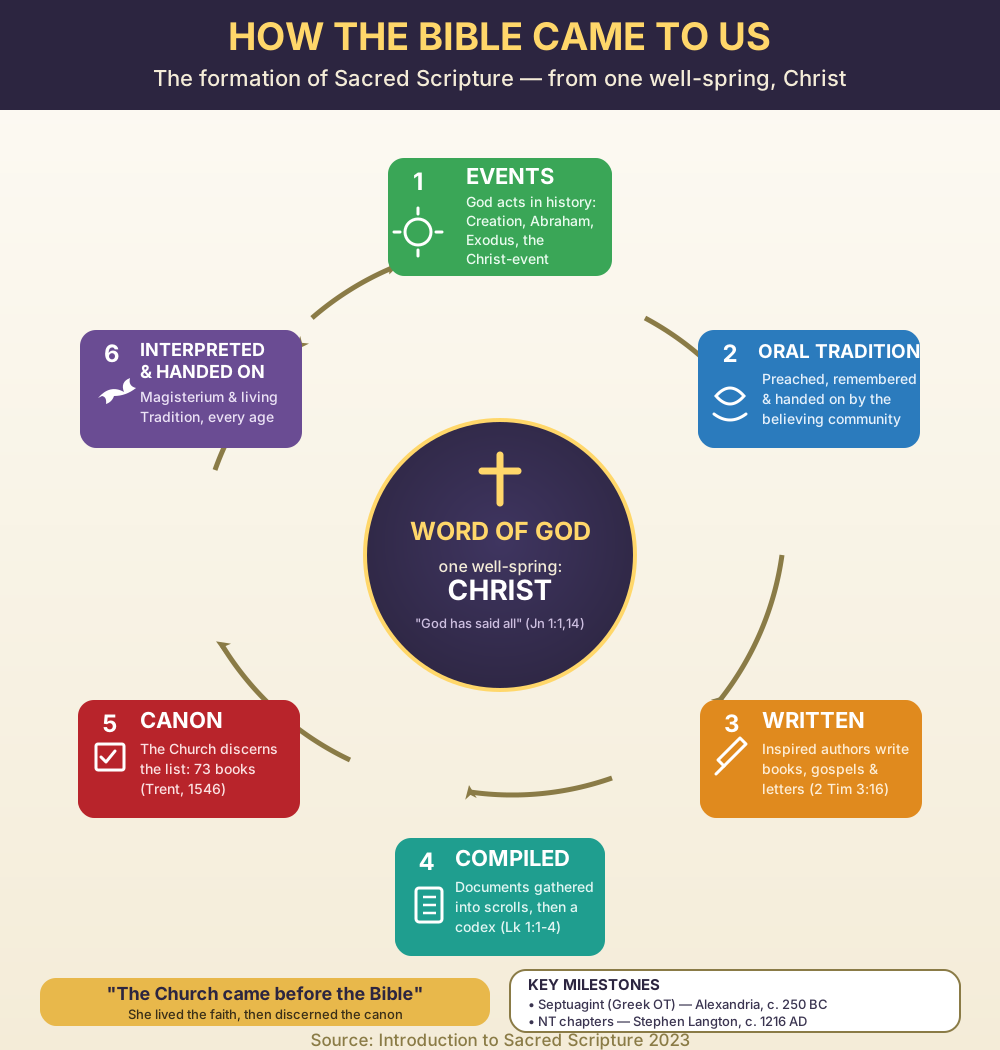
Key sequence to remember: The Church came before the Bible. The oral preaching of the apostles preceded the NT writings by decades, and it was the Church that later determined the Canon. “Christ did not give us the Bible directly: he gave us the Church, and it was out of the Church that the New Testament later arose.”
4. The long process of formation into today’s form
No biblical book was written in a single sitting. The notes give the formation chain (cf. Lk 1:1-4):
Events → Oral tradition → Written documents → Compilation into scrolls/books → Collection of scrolls into a codex.
For the OT in particular, the Pentateuch notes stress that written tradition was crystallised especially after the Babylonian Exile: when monarchy and priesthood ceased, the commandments and sayings had to be codified so they would be “available to all.” “By the rivers of Babylon” the Israelites looked back retrospectively, and “through the light of faith they started recording the events, remembering the promises of Yahweh.” Some milestones of the physical shaping of the text:
| Element | Who / When |
|---|---|
| Greek translation Septuagint (LXX) | Alexandria, c. 250 BC, under Ptolemy II; legend of 70(72) scholars |
| Names of the 5 books of the Torah | given by the LXX, 2nd cent. BC (Hebrew uses the first word: Beresit, Elle Shamot…) |
| Vowel-pointing of Hebrew (Masoretic Text) | Masoretes, 6th–9th cent. AD |
| OT chapter divisions | begun 10th cent. (Ben Asher), completed by Rabbi Nathan, 1524 |
| NT chapter divisions | Stephen Langton, c. 1216 |
| Verse divisions | Robert Stephen (Estienne), 1550/51 |
| Canon of 73 books authoritatively fixed | Council of Trent, 1546 |
(Total: 1189 chapters, 31,173 verses.) Witnesses to the text: papyri (e.g. P52, c. AD 135, John 18), the great uncials Codex Sinaiticus and Codex Vaticanus (mid-4th cent.), the Dead Sea Scrolls (found 1947), and ancient versions — LXX, Peshitta (Syriac), Vulgate (Jerome), Targums (Aramaic).
5. A rich library — variety of literary genres and hundreds of “authors”
“Bible” comes from Greek Biblos / Biblion / Biblia = “book/books”: it is one book and a collection of 73 books at the same time. It is “really a whole library, a compilation of many different books of various literary genres.” A genre is the literary form of a text; correct interpretation depends on reading “poetry as poetry, parable as parable, history as history” (Catechism 110). The notes lay out the genres in the Catholic divisions:
| Testament | Category | Genre / contents |
|---|---|---|
| OT | Historical (Law + History) | Pentateuch (Gen–Dt), Joshua → 2 Maccabees — narrative of salvation history |
| Prophetic | 4 Major + 12 Minor Prophets + Lamentations, Baruch — calls to repentance, Messianic promise | |
| Didactic / Wisdom | Job, Psalms, Proverbs, Qoheleth, Song of Songs, Wisdom, Sirach — worship and practical wisdom | |
| NT | Historical | 4 Gospels + Acts |
| Didactic | 13 Pauline letters + Hebrews + 7 Catholic Epistles | |
| Prophetic / Apocalyptic | the Book of Revelation (the one prophetic NT book) |
Smaller genres within a book also matter — parables, sayings, controversy dialogues, healing miracles, exorcisms, nature miracles (within the Gospels); royal psalms, laments, hymns (within Psalms). And the human authorship is genuinely plural — “hundreds of authors” across the centuries — yet Vatican II insists they are true authors (veri auctores), not secretaries: “with Him acting in them and through them, they, as true authors, consigned to writing everything and only those things which He wanted” (DV 11).
6. Uniqueness and unity — many books, one book
Behind the human diversity stands one principal Author. Inspiration (Greek theopneustos, “God-breathed”, 2 Tim 3:16) means “the Holy Spirit… is the Principal Author of the Sacred Scripture” — the word for breath/spirit is Ruah (Hebrew), Ruha (Syriac), Pneuma (Greek). The same Spirit who inspired the writing also inspires right reading: “the inspired Word of God is at the same time inspiring as well.”
And there is one centre — Christ. “Scripture is a unity by reason of the unity of God’s plan, of which Christ Jesus is the center and heart” (Catechism 112). “It is this Messiah who gives unity to the whole Bible. Thus the whole Scripture is to be read Christologically — even the Old Testament should be read with a view to find Christ there.” The two Testaments are two covenants (Latin testamentum = covenant; Heb. berith, Gk. diatheke): the old sealed at Sinai, the new in the blood of Jesus. St Augustine’s formula (DV 16): “the New Testament lies hidden in the Old, and the Old becomes manifest in the New.”
7. Each book progressively unfolds salvation history — Genesis to Revelation as one story
The Pentateuch notes summarise the whole Bible in three words: Creation — Uncreation — Recreation (and: Lost Land, Temple, Priesthood → restored). “Revelation began with creation, happened through places, events, people, and found its fulfilment in Jesus Christ.” Biblical history is not history in the modern sense — it is salvation history: Israel viewing its own life “under the divine providence and in the light of faith.” The arc:
| Period | Books | What God is doing |
|---|---|---|
| Primeval history | Gen 1–11 | Creation → Fall → call of Abraham |
| Patriarchs | Gen 12–50 | Promise to Abraham, Isaac, Jacob and the 12 sons; settlement in Egypt |
| Exodus (c. 1500–1200 BC) | Ex, Lev, Num, Dt | liberation from Egypt; Sinai Covenant; sin–punishment–repentance–forgiveness |
| Conquest & Judges (c. 1050–1030) | Josh, Judg, Ruth | entry into the Land; charismatic Judges |
| Monarchy (1030–587) | 1–2 Sam, 1–2 Kgs, 1–2 Chr | United then Divided Kingdom; Temple; Messianic prophecy of a king |
| Exile (587–539) | 2 Kgs 25, Lam, Jer 52 | Babylonian Exile; tradition written down |
| Post-exile / Persian (538–333) | Ezra, Neh, Hag, Zech, Mal | return, rebuilding the Temple; golden age of Wisdom literature |
| Greek–Hasmonean (333–63) | Dan, Judith, 1–2 Macc | resistance; awaiting the Messiah |
| Fulfilment | Gospels, Acts | the promised Messiah, Jesus of Nazareth — Word made flesh |
| Consummation | Revelation | “the new heaven and new earth”, the new Jerusalem — the end of time |
So the Bible is one unfolding plot: a covenant broken and renewed, a people lost and gathered, a Temple and Land lost and restored — all pointing forward. The prophets “all announced the coming of the future Messiah”; Deuteronomy promises “a new prophet like Moses” (Dt 18:15); even after all the forefathers died believing, “they did not receive what was promised” (Heb 11:39) — because the promise was Christ, who comes in the Gospels and whose reign is consummated in Revelation.
Key points: - Revelation = God’s self-gift “in deeds and words” (DV 2), in 4 stages: creation → humanity → Israel → Christ, the fullness; Scripture is its written record. - The Word is handed on (traditio) through Patriarchs → Prophets → Apostles, in four steps each era: Events → Oral tradition → Written documents → Canonization/Interpretation. - Scripture + Tradition are one well-spring (DV 9), not two sources; the Magisterium serves, not rules, the Word; the Church is older than the Bible. - Formed over c. 1000 years: events → oral → written → scrolls → codex; canon of 73 books fixed at Trent (1546). - A library (ta biblia) of many literary genres and hundreds of true authors (veri auctores) — yet one because of one Author (the Holy Spirit / Ruah) and one centre (Christ). - Read Christologically: “NT hidden in the OT, OT manifest in the NT” (Augustine). - One story: Creation → Uncreation → Recreation, Genesis to Revelation, culminating in Jesus and consummated at the end of time.
Connections: This theme ties Scripture to Christology (Christ the Word, Logos of Jn 1, the “exegete par excellence” of the Scriptures, Lk 24:27) and the Trinity (the Father who speaks, the Son who is the Word, the Spirit who inspires and interprets); to the sacraments (DV 21 pairs the table of the Word with the table of the Eucharist); to the Fathers (Augustine’s NT-in-OT; Chrysostom’s synkatabasis/divine “condescension” — God speaking in human words as the Word took flesh); and to the East-Syriac / Syro-Malabar tradition, whose Bible is the Peshitta (the seven Syriac manuscripts in the Mannanam Library witness its presence among the St Thomas Christians), whose ancient Gospel-book was Tatian’s Diatessaron (“through the four”), commented on by Mar Aprem (St Ephrem), and whose liturgy — like DV’s whole vision — reads all of Scripture as one movement toward Christ proclaimed in the Qurbana.
Q2 — The OT as the theological explanation of Israel’s history: Genesis–2 Kings as one work (the Enneateuch), the prophets across pre-exilic / exilic / post-exilic periods, and Deuteronomistic theology
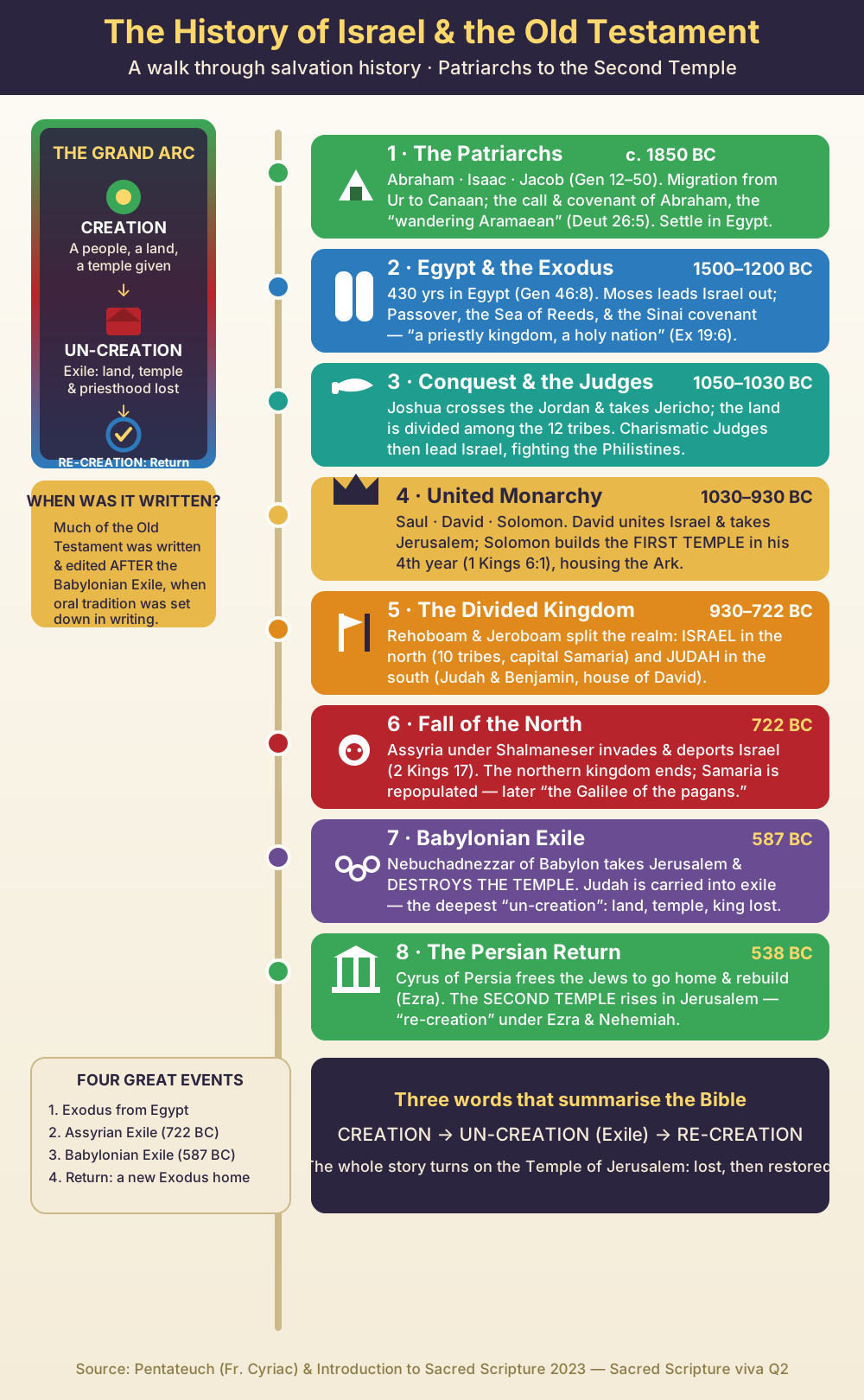
In short: Genesis through 2 Kings is read in the notes not as nine separate books but as one single literary work that runs from the creation of a people-with-a-land down to the loss of that land in the Babylonian Exile — and the prophets are the voices who interpret that same history. The whole thing is told backwards, from the standpoint of exiled Israel sitting “by the rivers of Babylon,” and the key it is written in is Deuteronomistic theology: one God, one chosen land, one chosen temple, one chosen Davidic king — fidelity brings the land, idolatry brings exile, and Yahweh’s mercy always keeps a remnant and brings them back. The professor (Fr. Cyriac Valiyakunnumpurath) compresses the whole Bible into three words: Creation – Uncreation – Recreation.
1. The governing key: Creation – Uncreation – Recreation
The notes summarise the entire Bible in three words and three losses:
| Word | What it means in Israel’s history | The “three losses” |
|---|---|---|
| Creation | Yahweh makes Israel one nation and gives them the Promised Land with himself at the centre | They have Land, Temple, Priesthood |
| Uncreation | Israel forgets Yahweh, falls into idolatry → slavery / exile; the land, king, temple, priesthood are taken away | They lose Land, Temple, Priesthood |
| Recreation | Yahweh keeps a remnant and brings them back to rebuild | They regain Land, Temple, Priesthood (Ezra–Nehemiah, Haggai) |
A crucial clarification (footnote of the note): “Creation” here does NOT mean the creation of the physical world — it means the creation of the people of God together with the Promised Land. Pope Benedict is cited: for the scientific truth of creation you do not go to the Bible; the Bible is the story of how the people of God came into being. Gen 1:1–2 (“void and formless, darkness over the deep”) is read as Israel’s pre-exilic chaos, and the “wind/Ruwah of God over the abyss” (in the Syriac Bible, the east wind) is Yahweh’s intention to renew them — leading to “a new heaven and new earth” (Isaiah 65–66; Rev 21).
The same three-beat pattern (creation → uncreation → recreation) is shown to recur all over the text: Flood (Noah = uncreation then a new world through the remnant Shem), Joseph (remnant preserved in Egypt), Exodus, and finally the Exile and return.
2. The four great events — the skeleton of salvation history
The notes name four main events around which the whole OT is built (Pentateuch note, “The Major Four Events”):
| # | Event | Date / detail from the notes | Reference |
|---|---|---|---|
| 1 | Exodus | From Egypt to the Promised Land; Israel in Egypt 430 years (≈ 6 generations); brought out by Moses to adore Yahweh | Gen 46:8; Ex 1:8 |
| 2 | Assyrian Exile | 723/722 BC — Shalmaneser invades the northern kingdom (Israel), destroys the temple, repopulates Samaria (“Galilee of the pagans”); priests and nobles taken | 2 Kgs 17:1–4 |
| 3 | Babylonian Exile | 587 BC — Nebuchadnezzar destroys Judah; (the Babylonians had earlier crushed Assyria — Nineveh razed 612 BC). The oral tradition is now written down. Cyrus the Persian then frees the Jews to rebuild | 2 Kgs 25 |
| 4 | Second Exodus / Return | Israel again journeys to the Promised Land to rebuild the Temple — the retrospective viewpoint of the biblical historians | 1 Kgs 17; Ezra–Neh |
The whole story therefore has two poles that mirror each other: the first Exodus (out of Egypt) and the second Exodus (back from Babylon). The history is written retrospectively from the exile: Israel, sitting by the rivers of Babylon (Ps 137), looks back, traces its origin, journey, hardships and the providence of Yahweh, and theologises it all.
The “two pillars” that hold up the OT (a memory hook from the note): Ex 1:8 — “a new king arose who did not know Joseph” (because Israel forgot Yahweh) and Judg 2:10 — “a new generation arose who did not know the Lord.” These two verses, plus Gen 46:8, mark the turning points of forgetting → uncreation → exile.
3. Genesis–2 Kings as ONE work: Tetrateuch → Pentateuch → Hexateuch → Enneateuch
The notes deliberately widen the unit step by step, showing why scholars increasingly read the books together. The central theme that binds them is always the Land.
| Term | Books included | Why grouped (from the notes) |
|---|---|---|
| Tetrateuch | Genesis–Numbers (first 4) | The old JEDP / Documentary Hypothesis (Yahwist, Elohist, Deuteronomist, Priestly) grouped these — but the note says this source-criticism is “outdated and not practical.” Deuteronomy stands apart |
| Pentateuch | Gen–Deut (“five scrolls”) | Term coined by the Septuagint (Alexandria, 2nd c. BC); Torah = “instructions,” later “laws” |
| Hexateuch | + Joshua | Joshua completes threads left open in the Pentateuch (see below) |
| Enneateuch | Genesis, Exodus, Leviticus, Numbers, Deuteronomy, Joshua, Judges, 1–2 Samuel, 1–2 Kings | Genesis–2 Kings as one literary work: from creation (of the people + land) to the uncreation of the land in 2 Kgs 17 & 25 |
Why Hexateuch? Three threads opened in the Pentateuch are closed only in Joshua: 1. Joseph’s bones — Joseph asks they be carried up (Gen 50:25); they are buried at Shechem (Josh 24:32). 2. The manna — given in the wilderness (Ex 16); it ceases when they eat the produce of the land (Josh 5:10–12). 3. Entry into the Land — the journey that begins at Sinai (Ex 19) and the Jordan border (Deut 1:1) is completed when Joshua crosses the Jordan, circumcises at Gilgal, keeps Passover, and takes Jericho (Josh 1–6).
Why Enneateuch? Fr. Cyriac’s class note states it directly: “Genesis–2 Kings form one unity… a single literary work that begins with the creation of the world and ends with the exile in Babylon. The central theme of the story is the land.” The unity rests on two concepts:
- (a) Centrality of the Land / Promised Land. Yahweh creates the land for Israel → promises it to the patriarchs → Israel travels through the wilderness (Ex–Num) → Joshua conquers it → the Judges defend it → under David and Solomon it becomes a united monarchy → then the division into North and South → the North falls to Assyria (722) and the South to Babylon (587) — the uncreation of the land (2 Kgs 17 & 25).
- (b) The Tabernacle / Presence of Yahweh in the midst. The tree of life in Eden (Gen 2:9) → the Ark of the Covenant (built so God dwells in the midst, crosses the Jordan, rests at Gilgal) → David brings it to Jerusalem → Solomon builds the Temple and places the Ark there → the Jerusalem Temple becomes the presence of the Lord. (And the Assyrians/Babylonians destroy it — uncreation.)
A clean summary line from the note: Moses led out of Egypt → Joshua conquered → Saul and David reigned → Solomon built the Temple → division → exile.
4. The hinge that anchors the whole thing: 1 Kings 6:1
This single verse is the note’s proof that the Enneateuch is one consciously-built arc. 1 Kgs 6:1: “In the 480th year after the Israelites came out of Egypt, in the fourth year of Solomon’s reign… he began to build the house of the Lord.” Solomon dates the Temple by the Exodus. The whole first half of the Bible is therefore: “From the Exodus to the building of the Jerusalem Temple” — because the Temple is the goal of the Exodus (the aim of the Exodus was to adore Yahweh in the place he would choose, Ex 3:18; 15:17–18; Deut 12:5).
5. The interpreters of this history: the prophets (“Former” and “Latter”)
In the Hebrew canon (TANAK — Torah, Nebiim = Prophets, Ketuvim = Writings), Joshua–Kings are the “Former Prophets.” The note explains why a history book is called prophecy: “the role of prophetic literature is to interpret the history of the people of Israel, their allegiance to the Torah of Yahweh and their closeness to the Temple of Jerusalem.”
- Non-literary prophets (no books of their own; their stories are inside Samuel–Kings): Nathan (with David), Ahijah, Elijah, Elisha.
- Literary prophets (who have books): begin from Amos, in the time of Jeroboam II / Uzziah. “The twelve from Amos.”
A prophet is defined throughout as the interpreter of the Torah and the one who unifies the twelve tribes (e.g. Elijah rebuilds the altar with 12 stones on Carmel). Moses is the first prophet (Deut 18:15: “a prophet like me will Yahweh raise up”); Joshua too acts as priest (mesherith Adonai, minister of the Ark, who sanctifies and offers sacrifice) and prophet (interpreter of the law in Josh 23–24).
The prophets by period (the heart of the question)
The note ties each literary prophet to a king and a crisis, spread across the three periods — pre-exilic, exilic, post-exilic — each with its theological background in the Torah / Deuteronomy (centrality of cult, monotheism, covenant fidelity, remnant, return):
| Period | Prophet(s) | Historical crisis / setting (from the notes) | Core message |
|---|---|---|---|
| Pre-exilic (8th c.) | Amos | Comes to the North at the death of Uzziah / reign of Jeroboam II; Syro-Ephraimite crisis (734); Tekoa near Jerusalem | Israel will be destroyed for idolatry & social injustice; oracles against the nations; yet “I will raise up the fallen booth of David” (9:11) |
| Pre-exilic (8th c.) | Hosea | Same Syro-Ephraimite crisis (734); 10 tribes taken by Assyria | Infidelity of Israel vs. fidelity of God; first prophet of monotheism; exile is chastisement, not the end — a return will come; “they shall seek David their king” (3:5) |
| Pre-exilic (8th c.) | Micah | Sennacherib’s attack on Judah, 701 (speech at Lachish; cf. Isa 36–38) | Judah judged like Israel; Messiah from the remnant (Mic 5); all nations stream to Mount Zion (4:1) |
| Pre-exilic / late 7th c. | Nahum | Fall of Nineveh (Assyria); Babylonian period 612–539 | Destruction of Assyria = Yahweh’s compassion (“Nahum” = compassion) on Israel |
| Pre-exilic (8th c.) → spanning all three | Isaiah (1–66) | 1–39: Assyrian crises — Syro-Ephraimite war (734), fall of Samaria (722), Sennacherib (701). 40–55: exile, hope of return under Cyrus. 56–66: post-exilic Zion theology | One scroll across pre-exilic, exilic and post-exilic time, unified by Zion theology (inviolable Jerusalem → new Jerusalem, Isa 65) |
| Late pre-exilic → exilic | Jeremiah | Ministry from Josiah’s 13th yr (627 BC) through Jehoiakim, Jehoiachin, Zedekiah to the fall of Jerusalem 587; priest of Anathoth (line of Eli/Abiathar) | “Yahweh will raise”; six verbs — pluck up, pull down, destroy, overthrow / build, plant; the “Prophet of Hope” (Book of Comfort, Jer 30–33); remnant & royal theology |
| Exilic | Ezekiel | Priest exiled with Jehoiachin in 597, prophesies in Babylon (by the river Chebar) from 593; part II after Jerusalem’s fall 586 | Structured like an Exodus story: Yahweh’s glory leaves the Temple and goes to the exiles (10–11), then returns (43); dry bones live again (37); “Adonai Shammah — the Lord is there” (48:35) |
| Post-exilic | Haggai, Zechariah, Malachi (also Zephaniah under Josiah) | The return under Persia; rebuilding of the Temple | “The silver and gold are mine” (Hag 2:8); restoration; “the Lord will be king over all the earth” (Zech 14:9) |
The exilic “gap” between the pre-exilic history (Exodus → conquest → loss of land) and the post-exilic history (return → rebuild Temple) is precisely where the exilic prophets — Second Isaiah, Jeremiah, Ezekiel — stand and give their hope. (Fr. Cyriac: this “gap, the exilic period, has its historical background in the prophecies of the exilic prophets.”)
Two key promises in Samuel–Kings that the prophets keep alive: - Unconditional promise to Judah/David (2 Sam 7:12–14; Hos 3:5) — why Judah returns from Babylon (the remnant). - Conditional promise to each king (1 Kgs 6:12) — why kings who sin are punished, but the tribe of Judah is preserved because of the Temple.
6. Deuteronomistic theology — the lens through which it is all written
The notes call the editor the Deuteronomistic historian (Dtr), whose “main thrust is to provide a theology of the history of Israel” (M. Liverani is cited: this is not “proper history” but an invented/theological history embedded with Dtr content). Deuteronomy is the foundation on which the Former Prophets are joined and “the basis of the whole Old Testament.” Deuteronomy itself opens Elle Haddevarim (“These are the words” Moses spoke) — a new beginning at the Jordan.
The Dtr historian connects the whole narrative through three ideologies:
| Dtr ideology | Anchor verse | How it runs through the books |
|---|---|---|
| 1. Centrality of the cult / Jerusalem Temple | Deut 12:5 — “the place the Lord will choose to put his name” | Eden (centre = tree of life) → Ark in the midst → Shiloh, Gilgal, Bethel → Jerusalem Temple; all feasts (Passover, Weeks, Sukkoth) draw every male to the one place; cf. Ezek 48 Adonai Shammah |
| 2. The Davidic throne / chosen king | Deut 17:14–20 — the law of the king (chosen by Yahweh, from among the brothers, must copy & read the Torah) | Judges fail → kingship → Saul rejected, David exalted → divided monarchy → exile → in the post-exilic age Yahweh alone is king (Zech 14:9) |
| 3. Access to the Land / its loss through idolatry | Deut 28 blessings & curses | Obedience = the land; idolatry = exile (loss of land, king, temple, priesthood — Hos 3:4) |
The Deuteronomistic “stereotyped formula” is shown clearly in Judges, repeating like a wheel and applying the Exodus theology (Ex 3:7–10) over and over:
Israel does evil in Yahweh’s sight → Yahweh’s anger, he “sells” (maakhar) them to an oppressor → Israel cries out → Yahweh raises up a deliverer/judge (shofet, equal to a saviour — the verb yasha’ behind Yehoshua / Yeshua, Jesus) → the land has rest → the generation dies, and it begins again (Judg 2:10).
This cycle deliberately shows that a judge can never permanently solve the problem → it pushes toward kingship, which also fails (Saul, then even David and Solomon sin, then the kingdom divides) → and so it points beyond itself to the true King, the Messiah / Jesus Christ. The same incompleteness drives the whole arc toward the post-exilic restoration of Yahweh’s own kingship — “the central point of the OT.”
7. How the formation of the Enneateuch + Prophets happened (in Dtr theology)
The note explains the process: while Israel lived in the land it was ordered by kings and priests, so little needed to be written. When both institutions ceased (with the Babylonian Exile), there arose the necessity to codify the commandments and sayings so they would survive and be available to all. Therefore the written tradition was particularly formed after the Babylonian Exile — Israel, by the rivers of Babylon, in the light of faith, recorded the events, remembering the promises to the fathers (especially Abraham — “as the stars of heaven and the sand of the shore”), the words of the prophets, and the hope of a Messiah who would liberate them. The oldest material survives as poetry (e.g. the Song of Miriam, Ex 15 — “one of the most ancient songs in Scripture”). Monotheism itself, the note stresses, “got deeply rooted at the end of the Babylonian Exile” and was then read back into the faith of the forefathers. This is why the whole work is retrospective theology: real historical events (read partly through archaeology and the Ancient Near Eastern Texts / ANET) given a single Deuteronomistic theological meaning.
Key points (for quick revision): - Enneateuch = Genesis–2 Kings as ONE work; theme = the Land; arc = creation of people+land → uncreation (2 Kgs 17 = North/722; 2 Kgs 25 = Judah/587). - Three-word summary of the whole Bible: Creation – Uncreation – Recreation = gain / lose / regain Land, Temple, Priesthood. - Four events: Exodus → Assyrian Exile (722) → Babylonian Exile (587) → Return (2nd Exodus); two mirroring poles, written retrospectively from Babylon. - Hexateuch proofs: Joseph’s bones, manna ceasing, entry into the Land (all resolved in Joshua). - 1 Kgs 6:1 (Temple dated from the Exodus, 480th year) = the hinge proving the unity; first half of Bible = Exodus → Jerusalem Temple. - Former Prophets (Joshua–Kings) = history; the prophets interpret it. Non-literary: Nathan, Ahijah, Elijah, Elisha. Literary: from Amos (Uzziah / Jeroboam II). - Prophets by period: pre-exilic Amos, Hosea, Micah, Nahum, Isaiah 1–39; exilic Jeremiah, Ezekiel, Isaiah 40–55; post-exilic Isaiah 56–66, Haggai, Zechariah, Malachi. - Deuteronomistic theology = the lens: 3 anchors — centrality of cult (Deut 12:5), Davidic king (Deut 17:14–20), land kept/lost by fidelity vs idolatry (Deut 28); expressed in the Judges stereotyped formula and Solomon’s Temple dedication. - Written tradition formed after the Exile, when king + priest ceased; oldest layers = poetry (Song of Miriam, Ex 15); monotheism crystallised at the end of the Exile.
Connections: - Christology / fulfilment: the failing judges → failing kings → true King Jesus (the shofet/yasha’ word-link to Yeshua); Joshua as priest-and-prophet prefigures Christ; Jesus the New Noah, the Ark = the Church; Hebrews 11:39 (the fathers “did not receive what was promised”). - Sacraments / liturgy: Passover at the three thresholds (Egypt, Sinai, Gilgal) and the liturgical procession round Jericho (Ark, trumpets, 7th-day worship) → the Eucharist as padheyam, “food for the journey” into the Promised Land (CCC 1068). - East-Syriac / Syro-Malabar: the Ruwah/east wind of Gen 1:2 in the Syriac Bible; the bema/bāma (“elevated place”) noted in the chapel; the Ark-in-the-midst → temple → sanctuary line that underlies the eastward-facing, Holy-of-Holies-centred shape of East Syriac worship and Adonai Shammah (“the Lord is there,” Ezek 48:35). - Trinity / Fathers: “Let us make man” (Gen 1:26) read by the Fathers as the Trinity; St Ephrem (the “robe of glory,” God forming man with a definite plan); Irenaeus on the rainbow-covenant of mercy.
Q3 — The Wisdom Books: their place in Hebrew Bible thought and continuing influence; faith in a divine cosmic Wisdom ruling the universe by rational, immutable norms; this literature as Word of God shaping liturgy, prayer, morality and philosophy of Israel, the NT and the Church; its symbolic language and literary styles over against gnostic and apocalyptic influence
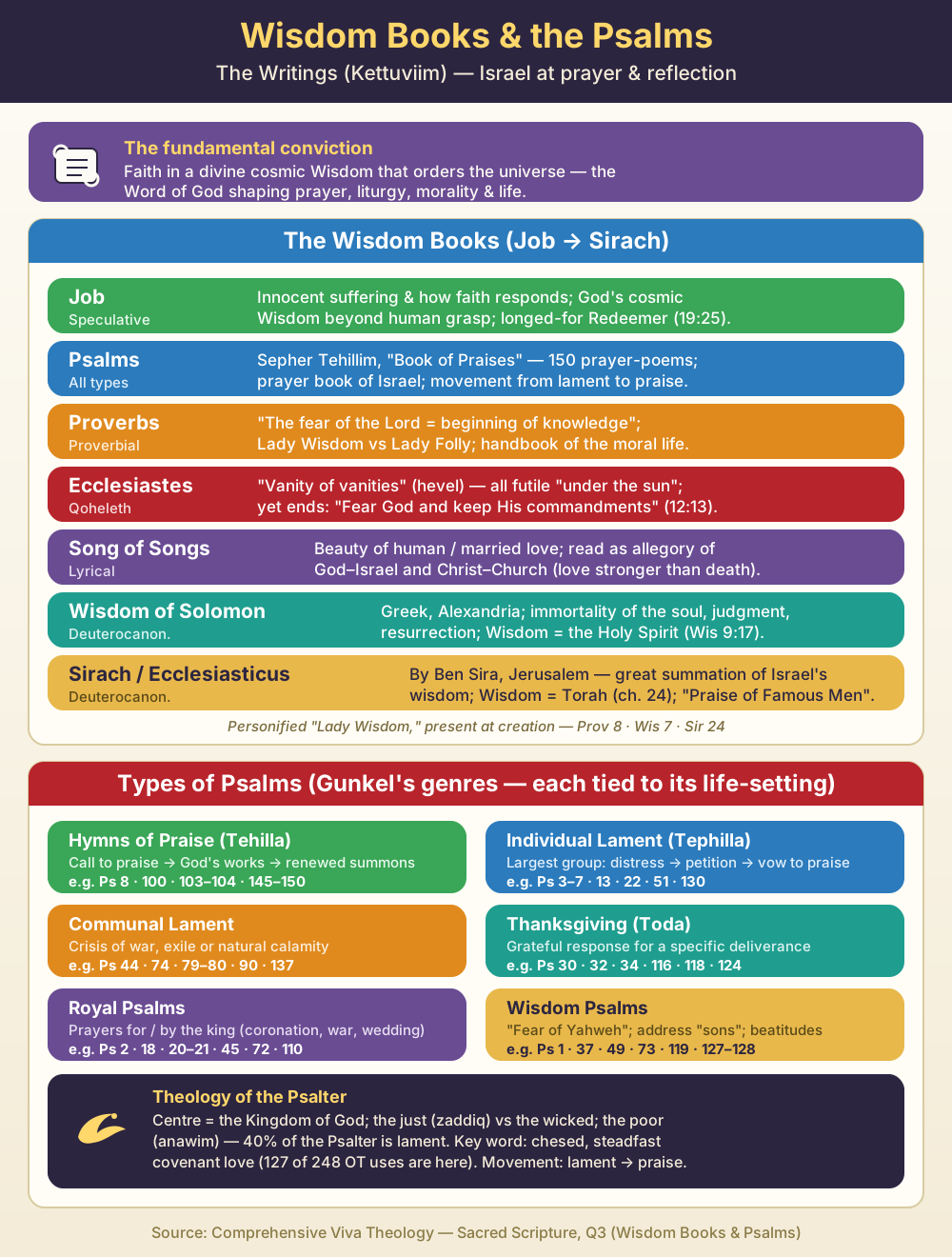
In short: The Wisdom Books (Job, Psalms, Proverbs, Qoheleth/Ecclesiastes, Song of Songs, Wisdom of Solomon, Sirach) form the third great division of the Old Testament — the Writings (Kettuviim). Their one fundamental conviction is that the Creator embedded a rational, unchanging order (Wisdom) into the cosmos, which the wise person discovers by observation, reverence (“the fear of the Lord”) and obedience, and lives in harmony with. Because this Wisdom is God’s own attribute personified — “Lady Wisdom,” present at creation (Prov 8; Wis 7; Sir 24) — the Wisdom literature became the seedbed of biblical prayer, moral teaching and philosophy, was read into the Church’s liturgy and sacraments, and flowed directly into the New Testament’s Christology (Christ as the Wisdom and Word of God) and pneumatology (Wisdom = the Holy Spirit, Wis 9:17). Against gnostic elitism and apocalyptic speculation, it speaks through ordinary, observable, symbolic language — proverb, poem, hymn, lament, dialogue, allegory — rooted in creation and daily life, not secret revelation.
1. Where the Wisdom Books stand in the Hebrew Bible
- The Jewish Bible has three parts — Torah (Law), Neviim (Prophets), Kettuviim (Writings) — a division already attested in the prologue of Sirach (c. 2nd cent. B.C.) and on Jesus’ lips in Luke 24:44 (“the law of Moses, the prophets, and the psalms”).
- The Christian tradition re-groups the books as Historical, Prophetical, and Wisdom (poetic/didactic) books.
- The Wisdom corpus proper is Job → Sirach, with Psalms as the prayer book of Israel (not all Psalms are wisdom Psalms — Gunkel isolated Pss 1, 37, 49, 73, 91, 112, 119, 127, 128, 133 as the wisdom type).
- Other “wisdom-flavoured” texts: the Creation Story (Gen 1-11), the Joseph Narrative (Gen 37, 39-50), the Succession Narrative (2 Sam 9-20; 1 Kgs 1-2), and Tobit 4. In the NT, the Letter of James is a model of proverbial wisdom.
2. The fundamental element: faith in a divine cosmic Wisdom
This is exactly the “common fundamental element” the question names. From the notes: - Hokmah (Hebrew חָכְמָה) / Sophia (Greek) = “wisdom.” Biblically it is not mere cleverness but the pursuit of godliness and right choices in light of God’s will — “The fear of the Lord is the beginning of wisdom” (Prov 9:10; cf. 1:7). - God built truth and order into reality itself; humans must seek that insight and live in harmony with the cosmos. Hence creation is more prominent than salvation-history here — there is no Exodus, no Sinai, no Davidic covenant in most wisdom books; instead, “God created the universe and expected humans to figure it out” (Job 38-41; Prov 8). - Wisdom is at once a human task (acquired by experience and observation) and a divine gift (given by God). It is personified (Prov 8; Wis 7; Sir 24) as a woman who shares with her friends the life she shares with God. - This Wisdom is the hidden, immutable principle active in the design of the cosmos which mortals cannot match — the very point of God’s speeches to Job (Job 38-41): can Job “discern” the order, the times, the limits by which God rules creation? He cannot; only God possesses that governing Wisdom. - Israel’s wisdom, though part of an international phenomenon (Edom — 1 Kgs 4:31; Jer 49:7; Egypt — Gen 41:8; 1 Kgs 4:30; Isa 19), was distinctive in insisting that true wisdom comes from God.
Six recurring family-traits of wisdom (per the notes): little interest in the Pentateuchal traditions (Sinai, covenant, cult); little concern with Israel’s history; a search for the meaning and mastery of life from experience; eagerness to wrestle with the hard problems (suffering, death, the prosperity of the wicked); curiosity about the universal experience of all peoples; and a commitment to proper moral behaviour.
3. The actual Wisdom Books — at a glance
| Book | Hebrew/Title | Type of wisdom | Key theme / contribution | Note on authorship & date |
|---|---|---|---|---|
| Job | (man of Uz) | Speculative | Innocent suffering; how a person of faith responds to suffering; God’s cosmic Wisdom beyond human grasp; longing for a Redeemer/mediator (19:25) | Author unknown; setting patriarchal; Hymn to Wisdom in ch. 28 |
| Psalms | Sepher Tehillim (“Book of Praises”) | All types (incl. wisdom Pss) | Prayer book of Israel; 150 poems; movement from lament to praise; Kingdom of God | Traditional: David; written c. 1000–250 B.C. |
| Proverbs | Mishlēy Shelōmōh / Mashal | Proverbial | Foundational wisdom book; “fear of the Lord = beginning of knowledge”; Lady Wisdom vs Lady Folly | Composite; Solomon + sages + Hezekiah’s men + Agur + Lemuel |
| Qoheleth / Ecclesiastes | “Qoheleth” = preacher (Gk Ekklesiastes) | Speculative | “Vanity of vanities” (hevel) — all is futile “under the sun”; ends “Fear God and keep His commandments” (12:13) | Trad. Solomon; “vanity” 35×, “under the sun” 29× |
| Song of Songs | Shir ha-Shirim / Canticles | Lyrical | Beauty of human / married love; allegory of God–Israel and Christ–Church | Trad. Solomon; poem/drama; bride (Shulamite), king, chorus |
| Wisdom of Solomon | (Greek original) | Speculative / theological | Immortality of the soul, final judgment, resurrection; Wisdom = Holy Spirit; the suffering “son of God” (2:12-20) | Written in Greek, Alexandria, c. 3rd c. B.C.–1st c. A.D.; not by Solomon |
| Sirach / Ecclesiasticus | “Wisdom of Jesus ben Sira” | Proverbial / summative | Massive summation of Israel’s wisdom; Wisdom = Torah (ch. 24); “Praise of Famous Men” (44-50) | Actually written by Ben Sira, Jerusalem, early 2nd c. B.C.; “Ecclesiasticus” = “the Church’s book” |
The canonical sequence has a logic: Job (set in patriarchal times) bridges from the historical books; Psalms (David) follow; then the Solomonic trilogy preserved in Hebrew — Proverbs, Ecclesiastes, Song; then the book preserved in Greek — Wisdom of Solomon; and last Sirach, the great late summary. The Councils of Hippo (393) and Carthage (397) spoke of the “five books of Solomon” (Proverbs, Ecclesiastes, Song, Wisdom, Sirach), tracing a “theological odyssey of the canonical Solomon”: he gains wisdom (Proverbs) → despairs because death makes it vain (Ecclesiastes) → discovers love is stronger than death (Song 8:6) → falls in love with Lady Wisdom and attains immortality (Wisdom).
4. Psalms — the prayer book that gathers all of Israel’s faith
The Psalter is the heart of Israel’s liturgy and prayer. Its etymology: Hebrew Sepher Tehillim (“Book of Praises”); Greek Psalterion (from psallein, “to pluck strings”). It is shaped as a five-book Torah-prayer (mirroring the Pentateuch — Midrash Tehillim: “As Moses gave five books of Law, so David gave five books of Psalms”), introduced by the Torah-Psalm 1 and the Royal Psalm 2, closing with the Hallel (Pss 146-150).
(a) Types / categories of the Psalms (Hermann Gunkel, 1862-1932, “Father of Form Criticism”; each genre tied to its Sitz im Leben, its life-setting in worship):
| Type (Hebrew) | What it is / form | Example Psalms |
|---|---|---|
| Hymn / Song of Praise (Tehilla) | Call to praise → reasons/modes (God’s attributes + works in creation & history) → renewed summons | 8; 29; 33; 100; 103-104; 113-114; 117; 145-150 |
| Individual Lament (Tephilla) | Largest group; address → description of distress → petition → expression of confidence → vow to praise | 3-7; 13; 22; 51; 88; 130; 140-143 |
| Communal Lament | Crisis of war/exile or natural calamity | 44; 74; 79-80; 90; 137 |
| Psalms of Confidence | An element of lament, expressing trust | 11; 16; 23; 62-63; 121; 125; 131 |
| Thanksgiving (Toda) | Grateful response for a specific deliverance: declaration → narration → testimony | Individual 30; 32; 34; 116; 138 · Communal 65-68; 107; 118; 124 |
| Royal Psalms | Prayers for/by the king (coronation, wedding, war, anniversary) | 2; 18; 20-21; 45; 72; 101; 110; 132; 144 |
| Wisdom Psalms | Reflections on living before God; “fear of Yahweh”; addresses “sons”; beatitudes | 1; 37; 49; 73; 91; 112; 119; 127; 128; 133 |
| Enthronement Psalms (“YHWH malak”) | Sub-type of hymn celebrating God as King | 47; 93; 96-99 |
| Songs of Zion | Sub-type of hymn celebrating God’s dwelling | 46; 48; 76; 84; 87; 122 |
| Penitential Psalms | (Six, within individual laments) | 6; 38; 51; 102; 130; 143 |
(b) Theology of the Psalter (the wisdom of the Psalter as Word of God): - The Kingdom of God is the theological centre — God as King (melek), Judge (shophet), divine Warrior (gibbor), enthroned in Zion; human kings are agents of His rule to establish justice and peace (Ps 72). - The just (zaddiq) — relational rather than merely moral: the one who trusts and entrusts himself to YHWH — versus the wicked (reshaim), the autonomous, godless persecutors. - The poor (anawim) — the oppressed and needy whose bitter prayer fills the laments (40% of the Psalter is lament). - Movement from Lament to Praise — the Psalter leads the worshipper through grief to thanksgiving; visible within single Psalms (Ps 22), among adjacent Psalms, and across the books (laments dominate Book I; praise dominates Books IV-V). “Suffering and glory go hand in hand.” - Chesed — the key theological word: steadfast, covenantal love. Of 248 OT occurrences, over half (127) are in the Psalter; “His steadfast love endures forever” (Ps 136, the Great Hallel, 26×). It echoes the self-revelation of God in Exodus 34:6. - Also: Shalom and justice for all (29; 46; 72; 85; 122), eco-theology / creation praise (8; 19; 104; 148), and the wrath of God (Ps 2:5, 12; cf. Ex 34:7).
5. As the Word of God: influence on liturgy, prayer, morality, philosophy
- Liturgy & prayer: The Psalter is the prayer of Israel and of the Church; the Wisdom hymns and laments shaped temple worship and continue in the Liturgy of the Hours.
- Morality: Proverbs is a “handbook of the moral life” — it anticipates moral theology, even mapping onto the later scheme of the seven deadly sins and opposing virtues (pride/humility, anger/patience, envy/joy, greed/generosity, lust/chastity, gluttony/temperance, sloth/diligence). Its core: virtue, prudence, the fear of the Lord, intolerance of laziness (sloth).
- Philosophy: The Wisdom of Solomon absorbs and answers Greek philosophy on its own ground — using technical Greek terms (immortality athanasia, providence pronoia, the four cardinal virtues — temperance, prudence, justice, fortitude, Wis 8:7) and refuting the worldview of the “ungodly” (atheistic chance, materialism, hedonism, relativism — Wis 2). It teaches the immortality of the soul, final judgment and resurrection, solving the impasse of Ecclesiastes.
6. Influence on the New Testament and the life of the Church
- Christology: Lady Wisdom — “acquired/created before all things,” the ordering principle of the cosmos (Prov 8:22) — is read by the Church as anticipating the Incarnation of the Second Person of the Trinity. Christ is “the righteous and wise man” of Proverbs; Job’s longed-for Redeemer/mediator (goel, Job 19:25; 9:33) is fulfilled in Jesus, “the one mediator between God and men” (1 Tim 2:5).
- The suffering “son of God” of Wisdom 2:12-20 is, after Isaiah 52-53 and Psalm 22, the closest OT parallel to the Passion of Christ.
- Pneumatology: Wisdom of Solomon virtually identifies Wisdom with the Holy Spirit (“Who has learned your counsel unless you have given wisdom and sent your holy Spirit?” Wis 9:17).
- Eucharist & sacraments: Lady Wisdom’s banquet of bread and mixed wine (Prov 9:1-6) was read by Cyprian of Carthage as the sacrifice of the Lord, and her seven pillars by Gregory the Great as “the sacraments themselves.”
- Mariology / the Church: the Valiant Woman of Proverbs 31 (an acrostic, “from A to Z”) was seen by the Fathers (Caesarius of Arles) as a type of the Church, and as anticipating Mary, Seat of Wisdom.
- Jesus himself teaches in meshalim / parabolai — proverbs and parables (Mt 13:34-35; Jn 16:25) — the very genre of the Wisdom tradition.
7. Symbolic language and literary styles — over against gnostic and apocalyptic influence
The Wisdom literature is “poetic” rather than prosaic — it conveys guidance for wise living, not information about events. It works through symbol and ordinary, observable reality (“reading the book of creation,” e.g. the ants and badgers of Prov 30:24-28), not through secret knowledge (gnosis) reserved for an elite, nor through coded visions of the end (apocalyptic). Its wisdom is available to anyone using reason and reverence — “one need not be an Israelite or live near the Temple to put Proverbs into practice.” Its tools are the literary forms below:
| Literary form / device | Where it appears |
|---|---|
| Mashal (proverb, parable, comparison, simile, riddle, taunt, allegory) | Proverbs, Sirach; taken up by Jesus |
| Parallelism (synonymous, antithetical, synthetic/step) | Proverbs, Psalms — Hebrew poetry rests on parallel ideas, not rhyme |
| Acrostic / alphabetic poem (A–Z = comprehensiveness) | Prov 31:10-31; Pss 25; 34; 111-112; 119; 145; Sir 51 |
| Hymn to Wisdom | Job 28; Prov 8; Sir 1; 24; 42-43 |
| Personification (Lady Wisdom vs Lady Folly) | Prov 1, 8, 9; Wis 7; Sir 24 |
| Dialogue / poetic drama | Job (the three cycles of speeches); Song of Songs |
| Numerical proverbs (“three things… four things…”) | Prov 30 |
| Allegory (love-poem read of God & His people) | Song of Songs |
| Encomium (“Let us now praise famous men”) | Sir 44-50 |
| Todah psalm (thanksgiving) | Sir 51; many Psalms |
Connections: The Wisdom corpus binds the whole canon together — Job and Ecclesiastes wrestle with the “exceptions” (innocent suffering, death’s apparent randomness) that Proverbs’ confident order seems to leave unanswered, and Wisdom of Solomon resolves them through immortality and judgment, opening directly onto NT eschatology and the Kingdom of God (the first OT use of basileia theou, Wis 10:10). Sirach 24 fuses Wisdom with Torah, healing the apparent gap between wisdom and salvation-history. In the East Syriac / Syro-Malabar tradition, this same instinct lives on: the liturgy and the Fathers (St Ephrem’s symbolic, “wisdom” theology through raze — types and symbols of creation) read Christ as the Wisdom and Word of God present from creation, exactly the move the Church Fathers made from Prov 8 to John 1.
Q4 — The life of Jesus in the Gospels as foundation of the NT: Synoptics more historical, John more theological, yet all “theology in history”; Jesus as the Good News and revealer of the Father; his fulfilment of the three messianic promises (prophet, priest, king); miracles inseparable from the Kingdom; the journey to Jerusalem as a “school for the disciples”
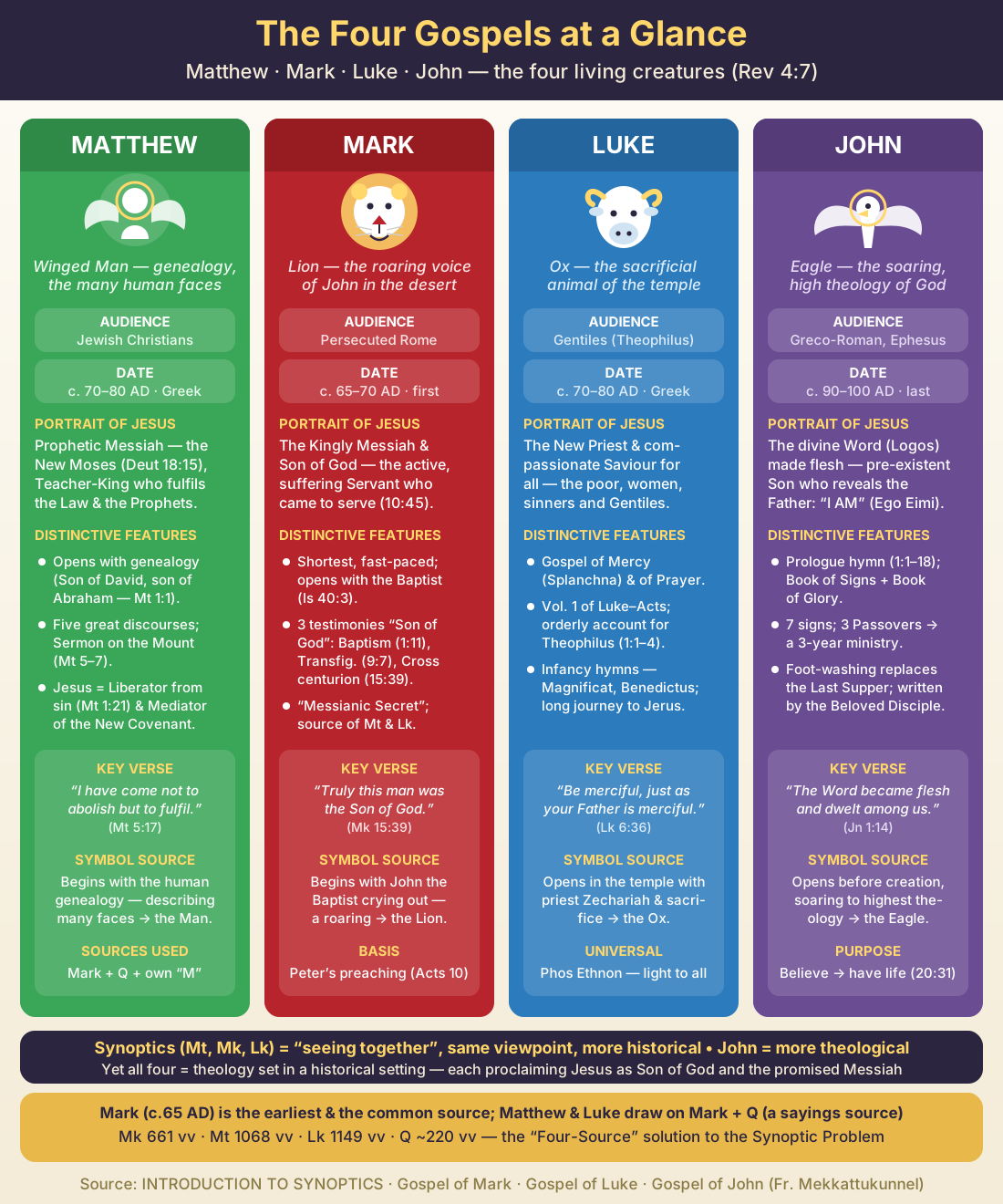
In short: The whole New Testament is built on the Jesus event — his life, words, deeds, passion, death and resurrection — which is the first of the four stages of Gospel-formation. The three Synoptics (Mark, Matthew, Luke) frame this event in a more historical, narrative way (geography, chronology, sequence of ministry); John frames it in a more theological, contemplative way (the eternal Logos, signs, glory). Yet none is “pure history” or “pure theology”: every Gospel is theology written in a historical setting and history read against a theological backdrop. Jesus himself is the Good News (Evangelion) and the supreme revealer of the Father, and the four Gospels affirm only two things about him — that he is Son of God and the promised Messiah of the Old Testament in whom the three messianic promises (prophet, priest, king) are fulfilled.
1. The Jesus event as the foundation of the whole NT — the four stages
Your Synoptics notes lay out four stages in the formation of the Gospels, and the first stage is the bedrock of everything that follows:
| Stage | What it was | Where it survives |
|---|---|---|
| 1. The life of Jesus (~33 yrs) | The Gospel existed in the person of Jesus of Nazareth — his life, words, deeds, suffering, death, resurrection | The four Gospels |
| 2. Apostolic Kerygma (proclamation, until ~100 AD) | Eyewitness apostles, commissioned by the Risen Lord, proclaim Jesus as Son of God and Saviour-Messiah | Acts of the Apostles |
| 3. Gospel in the life of the believing community (Acts 2:42) | Lived in four realms: Apostles’ teaching (Didache), fellowship (Koinonia), breaking of bread (Eucharistia), prayers (Eulogia) | Epistles, liturgy, Fathers |
| 4. Written form | Apostles / “apostolic men” composed the life of Jesus in writing for their communities (Mark wrote to the persecuted Christians of Rome) | The written Gospels |
The point for the viva: the NT is not first a set of doctrines but the record of a person. Paul’s letters (the earliest NT writing — 1 Thessalonians, c. 50–52, during the second missionary journey), the Catholic epistles, Acts and the Gospels all flow backward from stage 1. The Gospel in its fullest sense is therefore four things at once: Jesus’ birth/person, his message (the Kingdom of God, Mk 1:14), his Paschal mystery (1 Cor 15:1,3,4), and the book that contains his life (Mk 1:1).
2. Synoptics “more historical” — John “predominantly theological”
- “Synoptic” = syn (together) + optics (seeing) = “seeing together.” The first three Gospels share a common structure, order of narrative and much wording; their agreement-with-disagreement is the Synoptic Problem, solved by the Four-Source Theory (Mark + Q + M + L). Mark is the oldest (c. 65–70), Matthew and Luke depend on Mark and on Quelle (Q) — German for “source,” a collection of sayings of Jesus (c. 220–235 verses). This shared narrative skeleton (Galilee → journey → Jerusalem → passion) is what gives the Synoptics their historical, biographical feel.
- John is symbolised by the flying eagle (Rev 4:7; Ezek 1:10) because “as the eagle flies high, the theology of the fourth Gospel is higher than the Synoptics.” John opens before creation (Jn 1:1, the pre-existent Logos), calls the miracles signs (sēmeia) that reveal Jesus’ glory (doxa), and uses Greek philosophical categories (Logos) to proclaim the Gospel — Benedict XVI called it “a marriage between Greek philosophy and Judeo-Christian theology.”
Connections: John’s eagle-high theology still rests on eyewitness experience — “what we have heard, seen and touched, the Word of Life” (1 Jn 1:1). So even the most theological Gospel anchors itself in history.
3. Why ALL the Gospels are “theology in a historical setting / history in a theological backdrop”
This is the heart of the clause. Each Gospel does both:
- Luke is the most insistent on history — “an orderly account” for Theophilus written for asphaleia (truthfulness, reliability, solidity, Lk 1:3-4), dated against real rulers (Herod the Great BC 37–4; Augustus BC 27–AD 14; Tiberius AD 14–37; Lk 1:5; 2:1; 3:1). Yet “the whole theology of Luke is in the first two chapters” — annunciations, Magnificat, Benedictus, the visit of the Anatole (Dawn) from on high because of the splanchna (womb-mercy) of God. History and theology fused.
- Mark writes real geography (Galilee in the north, Judea in the south through Samaria; the dividing verse Mk 8:26-27) — but loads it with theology: the Messianic Secret (William Wrede), the three Son-of-God testimonies evenly placed at Baptism (1:11) – Transfiguration (9:7) – Centurion at the Cross (15:39), and Mk 1:1 = 14:61 = 15:39 all affirming “Son of God and Messiah.”
- Matthew roots Jesus in a real Jewish-Christian (Antioch) community in genuine crisis (the circumcision conflict of Acts 15 / Gal 2) — yet structures it theologically as five discourses mirroring the five books of the Torah, presenting Jesus as the New Moses.
- John narrates real feasts in real Jerusalem (Sabbath, Passover, Tabernacles, Dedication) — but each becomes the stage for replacement-and-fulfilment theology (Jesus replaces the temple, the manna, the water and light rituals).
So the Synoptics lean historical and John leans theological, but the formula holds for every one: theology written inside history.
4. Jesus himself as the Good News (Evangelion) and revealer of the Father par excellence
- Gospel / Evangelion comes from Isaiah 40:9-10 (Greek euangelion: eu = good + angelos = message-bearer) — the OT word for the message of liberation/redemption to the Babylonian exiles (“the Lord God comes with might… He will feed His flock like a shepherd”). Isaiah 40:3 already points to John the Baptist (the opening of Mark).
- In the NT the birth of Jesus itself is announced as Evangelion — Lk 2:10-12: “good news of great joy for all the people.” Its two marks: it is of great joy and it is for all. “The Lord is born = Evangelion.” Jesus is therefore not merely the bringer of good news; he is the Good News.
- Revealer of the Father: Jesus is the Logos — “a meaningful sound that communicates the inner plan of the one who speaks.” God’s inner plan = the redemption of fallen humankind; the Logos became flesh and pitched his tent among us (Jn 1:14), so “whatever he said and did is the revelation of God’s plan.” He is the Word of Truth (alētheia = to unveil): “Jesus removed the veil that covered the face of the Father” (Jn 14:7-9). To see Jesus is to see the Father.
Connections (Trinity): This revealing is Trinitarian — the Son reveals the Father, and the Spirit of Truth (Jn 15:26; 16:13), the Spirit of Jesus, leads the believer into all truth and into koinonia (communion) with the Holy Trinity (1 Jn 1:3). The whole purpose of the apostolic kerygma is to draw all people into this Trinitarian communion.
5. The THREE messianic promises — prophet, priest, king — and their fulfilment
In the OT there is no single direct promise of a Messiah, but God repeatedly promises a future saving figure with priestly, kingly or prophetic character. Because these three offices were entered through anointing, the figure is called Messiah / Christ (“anointed one”). Every OT promise has a double fulfilment: an immediate, partial fulfilment in Israel’s history, and the messianic, complete fulfilment in the eschatological Messiah, Jesus.
| Promise | Key OT text | Content | Fulfilled in Jesus | Gospel that highlights it |
|---|---|---|---|---|
| Priestly | Gen 22:18 (“by your offspring all nations gain blessing”); cf. Num 6:22-27; Lev 9:22 | A son of Abraham who blesses all nations (blessing = priestly function) | Jesus the Son of Abraham (Mt 1:1); the Risen Lord blesses all (Lk 24:50-51) | Luke — “the New Priest” (opens with priest Zechariah who cannot complete the blessing, Lk 1:22) |
| Kingly | 2 Sam 7:12-14 (Davidic covenant) | A son of David who builds God’s house, whose kingdom lasts forever, who is Son of God | Jesus, Son of David & Son of God; everlasting Kingdom; the true temple is his body (Jn 2:19) | Mark — the Kingly Messiah (preaching of the Kingdom, parables, death on the cross) |
| Prophetic | Deut 18:15 (“a prophet like me… you shall heed him”) | A prophet like Moses, spokesperson of God, also anointed | Jesus the New Moses; “Listen to him” (Mk 9:7 at Transfiguration) | Matthew — the Prophetic Messiah / New Moses (Mt 5–7 interprets the law of Moses) |
The Transfiguration (Mk 9:2-8) gathers all three: Jesus on the mountain with Moses (Torah/the Law) and Elijah (the Prophets), with the Father’s voice “This is my beloved Son, listen to him” (Deut 18:15). The viva-line to remember: “There are only two things signified in the four Gospels — Jesus is the Son of God (his divine nature), and the promised Messiah (priestly, kingly, prophetic). Everything else is seen in the light of these two.”
Connections: The three offices map onto the classic systematic-theology triplex munus of Christ (and of every baptised person who shares in Christ’s prophetic, priestly and kingly mission). In the Syro-Malabar / East-Syriac tradition this is felt liturgically: the priest, like the Risen Lord of Lk 24:50-51, still blesses the people — “We are to be ordained to continue this blessing” — and Mar Ephrem’s epiclesis-theology (“what happened in the womb of Mary happens on the altar”) ties the kingly-Davidic temple-promise to the Eucharist as the sacramental extension of the incarnate body of Christ.
6. Miracles inseparable from the message of the Kingdom
- The only subject of Jesus’ proclamation was the Kingdom of God (Mk 1:14-15: “The time is fulfilled, the Kingdom of God is at hand — repent and believe”; Mt 4:17 “Kingdom of Heaven,” where Heaven is a reverent synonym for God). “Kingdom of God” means God ruling in human history as its Lord, in his incarnate Son.
- In the Synoptics, the Galilean ministry (Mk 1:14–8:26) is “mainly healing as part of establishing the Kingdom of God.” The miracle and the message are one act: the healings are the Kingdom breaking in. (Note from Luke: Jesus “was not doing away with sickness” abstractly — “through his life, Jesus was proclaiming and also establishing the Kingdom of God.”) The programmatic speech at Nazareth (Lk 4:18, fulfilling Isa 61) defines the Good News to the poor as four concrete liberations — release to captives, sight to the blind, freedom to the oppressed, the Jubilee year — i.e. the miracles enact the Kingdom-message.
- In John the link is made explicit by vocabulary: a miracle is a sign (sēmeion, 2:11) that points beyond itself to the glory (divinity and messiahship) of Jesus; the sign produces faith, and faith produces eternal life (Jn 20:30-31). The signs are not wonders for their own sake but revelations of who Jesus is — so again, inseparable from the message.
Connections: Mark’s healing of the blind man at Bethsaida (Mk 8:22-26) and blind Bartimaeus (10:46-52) “frame” the journey section by inclusion, turning physical sight into the symbol of recognising Jesus as Son of God and Messiah — the Fathers’ “luminous eye.” Miracle and Kingdom-proclamation are the same revelation seen from two sides.
7. The journey to Jerusalem as a “school for the disciples”
In all the Synoptics, the central section is the journey from Caesarea Philippi / Galilee up to Jerusalem (Mark 8:27–10:52; Luke 9:18–19:27). It begins with Peter’s confession (“You are the Messiah,” Mk 8:29; “the Messiah of God,” Lk 9:20; “Son of the living God,” Mt 16:16) and is structured around the three Passion predictions (Mk 8:31; 9:31; 10:33-34), each followed by the disciples’ misunderstanding and then a teaching on discipleship. Jerusalem itself is “the symbol of passion, death and resurrection,” so the road is the curriculum: the disciple must learn that the way of the Master — and so of the disciple — is “the way of suffering, death and resurrection.”
Luke develops this most fully: his journey (Lk 9:51 — “he set his face to go to Jerusalem”) is literally “a school for his disciples,” teaching 12 lessons on “being on the Way” (Acts later calls Christians people of “the Way”):
| # | Lesson on “being on the Way” | Text |
|---|---|---|
| 1 | Welcome even those who reject you | Lk 9:51-55 |
| 2 | The Way demands real sacrifices | Lk 9:57-62 |
| 3 | The one on the Way is an apostle (a sent one) | — |
| 4 | Discipleship implies a life of repentance | Lk 10:13-15; 13:5 |
| 5 | The Way leads to eternal life — enter by the narrow door | Lk 13:22-30 |
| 6 | Only through service to the brethren does one enter eternal life | Lk 10:25-37 (Good Samaritan); 10:38-42 |
| 7 | The one on the Way must live a life of prayer | Lk 11:9-10 |
| 8 | The disciple is salt of the earth and light of the world | Lk 11:33-36; 14:34-35 |
| 9 | His righteousness must surpass the scribes’ and Pharisees’ | Lk 11:37-54 |
| 10 | You cannot love money and be on the Way | Lk 14:33 |
| 11 | Be vigilant not to scandalise the least one | Lk 16:10-15 |
| 12 | Be ready to forgive unconditionally | Lk 17:1-4 |
Connections (East-Syriac): The “Way” theme is dear to the Syro-Malabar self-understanding — “Thomas the Apostle came and made known the Way (mārgam)”; the Mārgam Kali preserves exactly this image of Christian life as a journey of discipleship to Jerusalem/heaven, the road of the cross opening onto resurrection.
One-line summary for the examiner: The NT stands on the life of Jesus (stage 1 of Gospel-formation); the Synoptics tell that life historically and John theologically, yet every Gospel is theology in a historical setting; Jesus is himself the Evangelion and the par-excellence revealer of the Father; he fulfils the threefold OT messianic promise — prophet (Matthew/New Moses), priest (Luke), king (Mark) — proclaiming the Kingdom of God whose in-breaking is his miracles/signs; and the journey to Jerusalem is the school in which the disciples learn that the Master’s way of suffering, death and resurrection is their own.
Q5 — Overview of Acts, the Letters of Paul, Hebrews, the Catholic Epistles, Revelation, and the Greek background
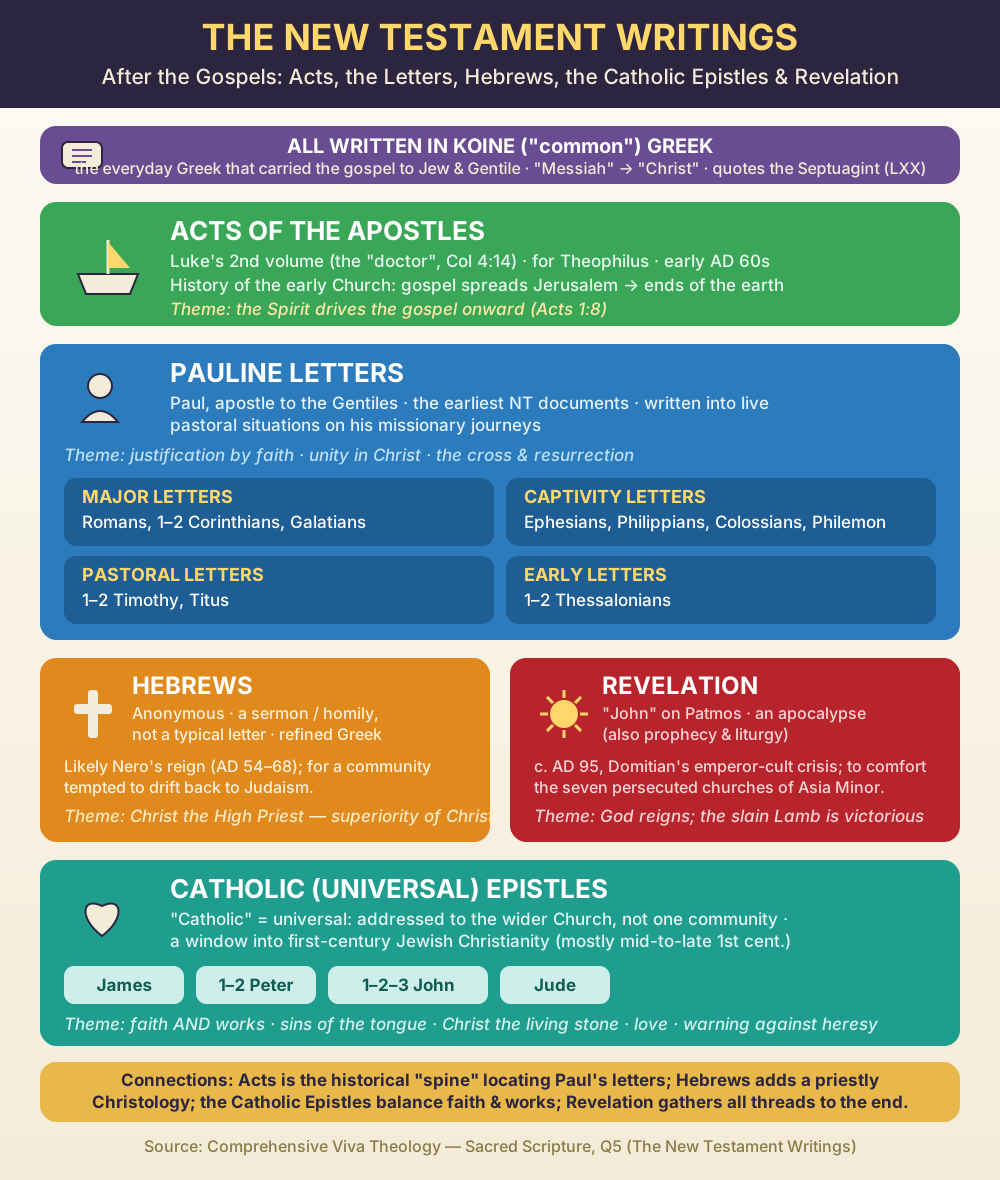
In short: The non-Gospel New Testament falls into five writing-groups — the history (Acts), the Pauline letters (the apostle’s own theology in letter form), the homily called Hebrews, the seven Catholic (universal) Epistles, and the apocalypse of Revelation — all composed in Koine (“common”) Greek, the everyday Greek of the Hellenistic world that the Gospel used to reach both Jew and Gentile.
Acts is Luke’s second volume (after his Gospel), written for Theophilus in the early AD 60s, tracing how Christianity grew “in only thirty years” from a handful in Jerusalem to Rome. Paul’s letters are his own correspondence, the earliest NT documents, written into live pastoral situations on his missionary journeys. Hebrews is anonymous, not a typical epistle but a sermon/homily in highly refined Greek, arguing the superiority of Christ. The Catholic Epistles (James; 1–2 Peter; 1–2–3 John; Jude) are called “catholic” = universal because most are addressed to the wider Church rather than one community; they give us a window into first-century Jewish Christianity. Revelation is an apocalypse (and prophecy and liturgy), born in a time of crisis (Domitian’s emperor-cult, c. AD 95), assuring the persecuted churches that God reigns and will win the final victory.
The Greek background: the whole NT was written in Koine Greek. Greek had become the common medium of trade, administration and culture across the Roman East (Hengel). This is why the Hebrew “Messiah” (“anointed one”) becomes the Greek “Christ” (Acts 11:26, where believers were first called Christianoi in Antioch), and why authors quote the Septuagint (LXX), the Greek Old Testament. Refined Greek rhetoric marks Hebrews, 1–2 Peter and James; the notes repeatedly weigh whether a Galilean fisherman (Peter) or “the Lord’s brother” (James) could write such elevated Greek.
| NT writing-group | Author (as notes present) | Date | Purpose / occasion | Key theme |
|---|---|---|---|---|
| Acts of the Apostles | Luke (the doctor, Col 4:14; Paul’s companion — the “we” passages) | early AD 60s | A trustworthy account for Theophilus; show Christianity is no threat to Rome | Spread of the gospel from Jerusalem “to the ends of the earth” by the Spirit (Acts 1:8) |
| Pauline Major Letters (Rom, 1–2 Cor, Gal) | Paul, apostle to the Gentiles | Gal c. AD 54–55; 1 Cor on 3rd journey; Rom c. AD 57–58 | Correct factions, defend his apostleship, settle circumcision/Law disputes | Justification by faith; unity in Christ; the cross; resurrection |
| Letter to the Hebrews | Anonymous (early guesses: Paul/Luke/Priscilla — none accepted); a learned 2nd-generation Jewish-Christian preacher | likely Nero’s reign, AD 54–68 | Encourage a persecuted community tempted to drift back to Judaism | Superiority of Christ (over angels, Moses, the Levitical priesthood, the old covenant & sacrifices); faith & perseverance |
| Catholic (universal) Epistles (Jas; 1–2 Pet; 1–2–3 Jn; Jude) | James (the Lord’s brother); Peter; “the Presbyter”/John; Jude | mostly mid-to-late 1st century (e.g. James in the 50s; 1 Pet early 60s) | Refute false teaching, strengthen ethics, encourage in face of delayed Parousia & martyrdom | Faith and works; sins of the tongue; Christ the living stone; love; the Antichrist; warning against heresy |
| Revelation (Apocalypse) | “John” on Patmos (apostle? a prophet of the Johannine circle) | c. AD 95 (end of Domitian’s reign) | Comfort & challenge seven churches of Asia Minor under pressure / emperor-cult | God reigns; the slain Lamb is victorious; New Jerusalem; call to faithful witness (martyria) |
| Greek background | — (LXX = Greek OT) | Hellenistic / Koine era | The common language that carried the gospel to Jew & Gentile | “Messiah” → “Christ”; quotation of the LXX; rhetoric of Hebrews/1 Pet/James |
Connections: Acts is the historical “spine” that lets us locate Paul’s letters in his journeys; Hebrews develops a priestly Christology (Christ the High Priest after Melchizedek) that complements Paul’s justification theology; the Catholic Epistles (especially James) sit in apparent tension with Paul on faith/works (resolved as initial vs. ongoing justification); and Revelation gathers all the threads into the consummation of salvation history. In the East Syriac / Syro-Malabar tradition the original NT canon (Peshitta) did not include 2 Peter, 2–3 John, Jude and Revelation [supplemented] — a memorable footnote to the “Catholic Epistles + Revelation” grouping.
Q6 — Marriage (Eph 5:21-33) and the household code (Eph 6:1-9)
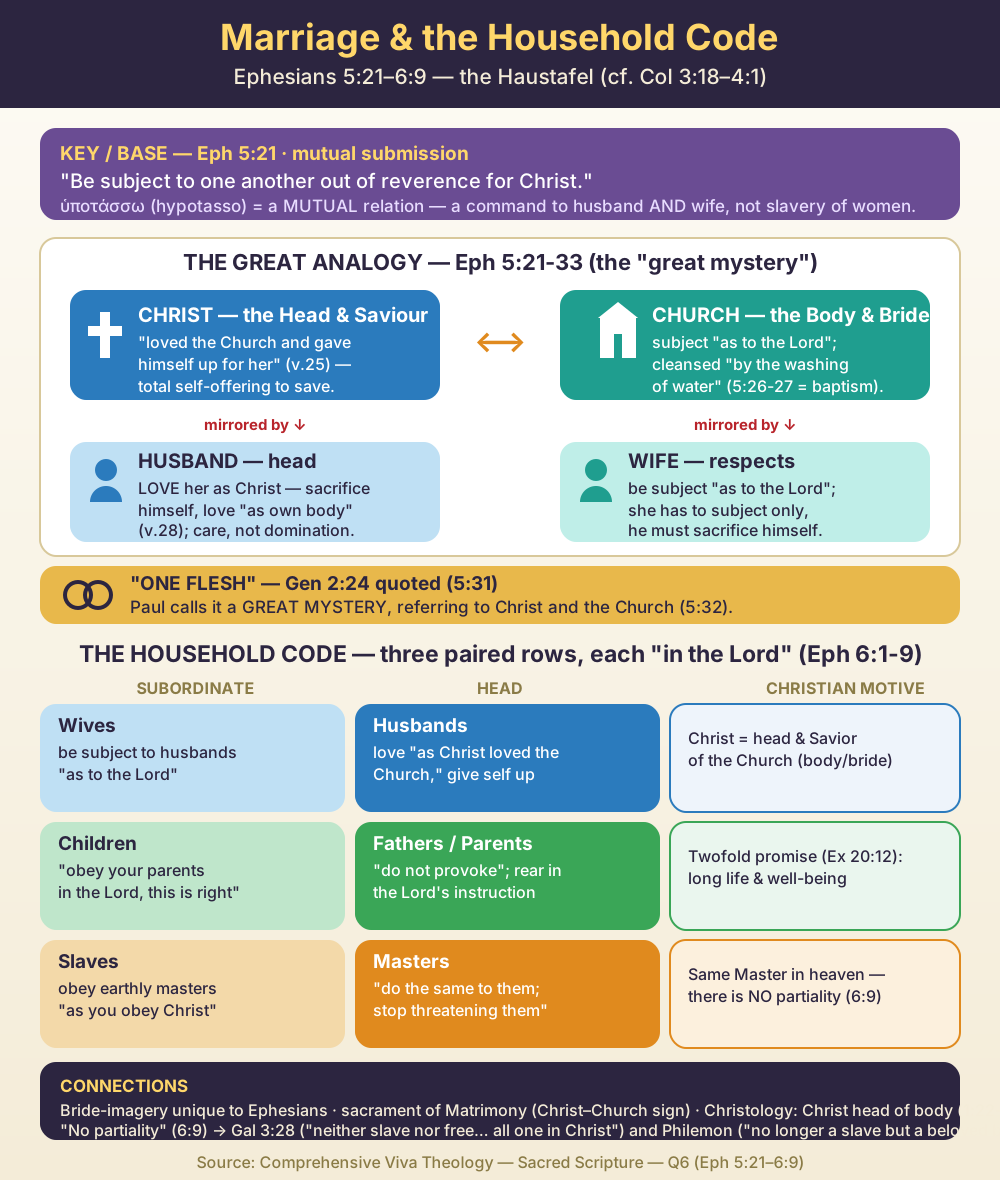
In short: Eph 5:21-6:9 is the Code of Conduct (Haustafel / “household conduct”), an ethical teaching parallel to Col 3:18-4:1, addressed to three pairs — wives/husbands, children/fathers, slaves/masters. Its theological key is that marriage is read off the relationship of Christ and the Church, and the whole section is governed by the opening principle of mutual submission (5:21).
The governing verse (5:21). “Be subject to one another out of reverence for Christ” (Ὑποτασσόμενοι ἀλλήλοις ἐν φόβῳ Χριστοῦ). The notes stress this verse is the base of the entire account and is “a command both to husband and wife” — not the subjection of women alone. The verb is ὑποτάσσω (hypotasso) = subject, subordinate, subject oneself; the notes add it denotes a mutual relation, so “this word in no means slavery of women.”
Wives and husbands (5:21-32). Christ-and-Church is the model: - Wives are to be subject to their husbands “as to the Lord” (ὡς τῷ κυρίῳ) — “for the husband is the head of the wife just as Christ is the head of the Church, the body of which he is the Savior.” - Husbands are to “love their wives, just as Christ loved the Church and gave himself up for her” (v. 25), and to love them “as they do their own bodies” (v. 28). - The notes draw out the asymmetry of effort: “A husband has to sacrifice himself whereas a wife has to subject only.” The husband is protector/saviour of the wife as Christ saves the Church — “submission is not a kind of slavery”; “a total giving or offering to save the people.” - Other markers: 5:26-27 (cleansing “by the washing of water by the word”) = indication of baptism; 5:28 = consider the other as yourself; 5:29 = care for the partner; 5:31-32 quotes Gen 2:24 (“the two shall become one flesh”), which Paul calls a great mystery referring to Christ and the Church.
Children and parents (6:1-4). “Children, obey your parents in the Lord, for this is right.” Honouring father and mother carries the two promises of Ex 20:12 / Deut 5:16 — long life and well-being. “Fathers, do not provoke your children to anger” (cf. Col 3:21 — provocation discourages) but “bring them up in the discipline and instruction of the Lord” (= teachings of Jesus, Gospel values, Church teachings).
Slaves and masters (6:5-9). “Slaves, obey your earthly masters with fear and trembling as you obey Christ.” Strikingly, “Masters, do the same to them. Stop threatening them, for you know that both of you have the same Master in heaven, and with him there is no partiality.” The notes gloss “do the same to them” as mutual respect — the radical Christian element is the shared heavenly Master who shows no partiality.
| Pair | Command to the “subordinate” | Command to the “head” | Christian motive |
|---|---|---|---|
| Wives / Husbands | Be subject “as to the Lord” | Love “as Christ loved the Church,” give self up | Christ = head & Savior of the Church |
| Children / Fathers | Obey “in the Lord” | Do not provoke; rear in the Lord’s instruction | Promise of long life & well-being (Ex 20:12) |
| Slaves / Masters | Obey “as you obey Christ” | Do the same; stop threatening | Same Master in heaven; no partiality |
Key points: - The section is “household conduct” / Code of Conduct, like Col 3:18-4:1. - 5:21 (“be subject to one another”) is the key/base — mutual submission “out of reverence for Christ.” - Marriage mirrors Christ (head/Savior) and the Church (body/bride); husband’s call is self-sacrificial love, not domination. - Baptismal echo (5:26-27); Gen 2:24 cited as the “mystery” of Christ and Church. - Children: obey + the honour-commandment’s twofold promise; fathers: do not provoke. - Slaves/masters relativised by the one heavenly Master with no partiality.
Connections: The Church-as-bride imagery is noted as unique to Ephesians among the Pauline letters (one argument used in the authorship debate). It links to sacramental theology of Matrimony (the spousal union as sign of Christ-Church) and to Christology/ecclesiology (Christ the head of the body, Eph 1:22-23). The “same Master, no partiality” of 6:9 connects to Gal 3:28 (“neither slave nor free… all one in Christ”) and to Philemon, where Paul asks that the slave Onesimus be received “no longer as a slave but a beloved brother.”
Q7 — The Christological Hymn of Philippians 2:5-11 (kenosis, humiliation, exaltation)
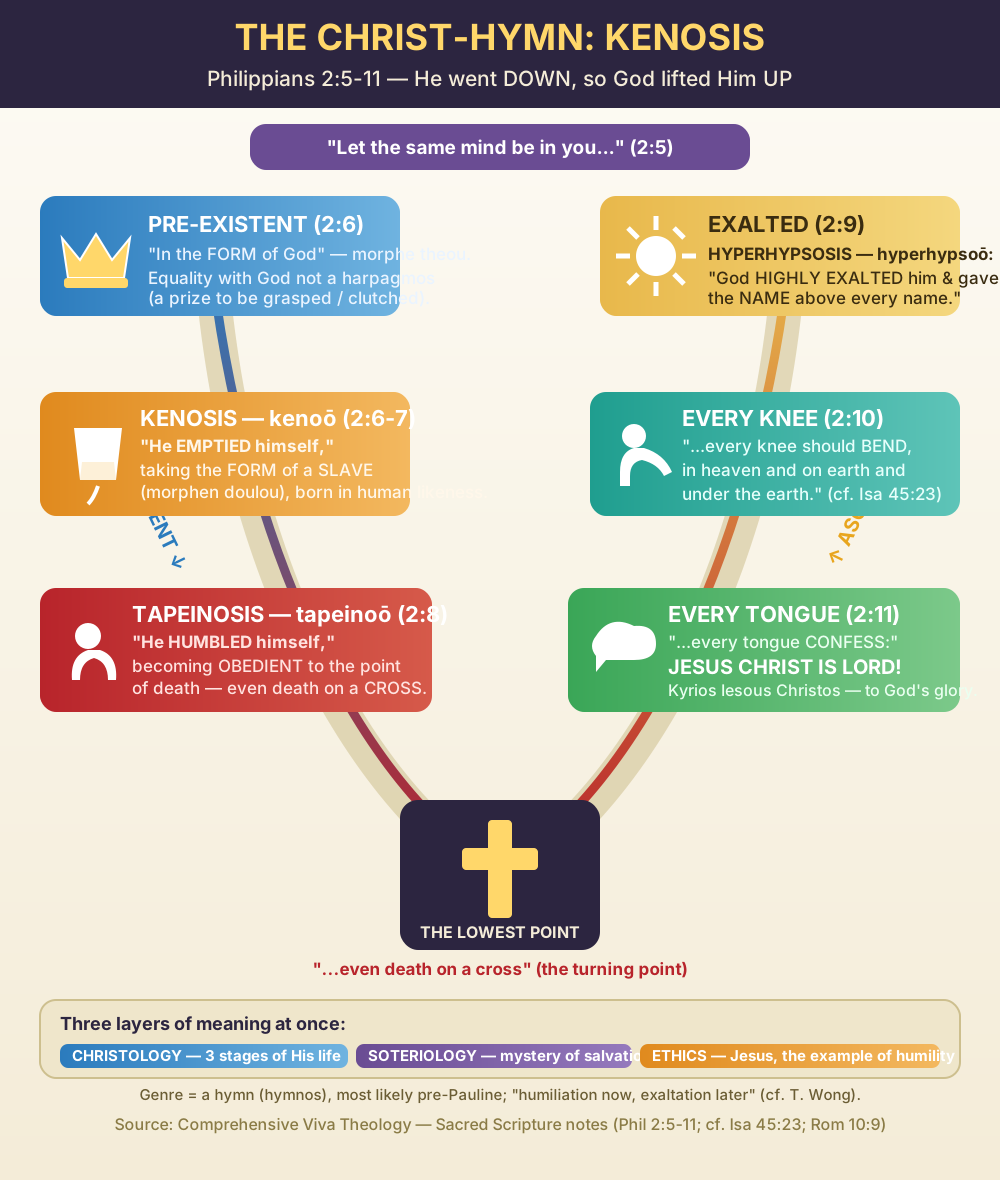
In short: Phil 2:6-11 is a hymn (Gk ὕμνος / hymnos = “a song of praise”), most likely a pre-Pauline hymn the Philippians already knew, which traces Christ through three stages — pre-existence, self-emptying humiliation, and super-exaltation — and which Paul deploys for an ethical purpose: “Let the same mind be in you that was in Christ Jesus” (2:5).
Literary setting. The hymn is the climax of the appeal to unity and humility in 1:27-2:18: 1:27-30 (fearlessness before opponents), 2:1-4 (humility within the community), 2:5-11 the Christ-hymn as the basis of the whole exhortation, 2:12-18 (final exhortation — “work out your own salvation with fear and trembling”). Most scholars regard it as a pre-Pauline hymn probably taught by Paul on his first visit; its hymnic features are a worship setting, an introductory relative pronoun (“who [ὅς]…” in 2:6), rhythmic style, and high Christology [supplemented: comparable hymns are Col 1:15-20; Eph 1:3-14; John 1:1-18].
Structure (the three movements). The notes label them with their Greek verbs:
| Stage | Verses | Greek term | Content |
|---|---|---|---|
| Pre-existent Christ | 2:6 | (ἐν μορφῇ θεοῦ — in the form of God) | “though he was in the form of God, did not regard equality with God as something to be exploited/grasped” |
| Kenōsis (Emptying) | 2:6-7 | κενόω / kenoō | “but emptied himself, taking the form of a slave (μορφὴν δούλου), being born in human likeness” |
| Tapeinōsis (Humiliation) | 2:8 | ταπεινόω / tapeinoō | “he humbled himself and became obedient to the point of death — even death on a cross” |
| Hyperhypsōsis (Super-exaltation) | 2:9-11 | ὑπερυψόω / hyperhypsoō | “Therefore God also highly exalted him and gave him the name above every name… every knee should bend… every tongue confess Jesus Christ is Lord (κύριος Ἰησοῦς Χριστός), to the glory of God the Father” |
Two pivotal words: - μορφή (morphē) = “form or nature” — Christ is in the form/nature of God, then takes the form of a slave. - ἁρπαγμός (harpagmos) = “a thing to be seized or greatly desired, a prize, something to hold on to.” Christ did not treat equality with God as a harpagmos to be clutched. - κενόω (kenoō) = self-emptying; the notes define kenosis as “taking away the prerogative status, self-emptying.”
Threefold theology. The notes name three layers of meaning at once: 1. Christology — the hymn alludes to the three stages of the life of Jesus (pre-existent, earthly, exalted). 2. Soteriology — Paul “attempts to explain the mystery of Jesus Christ and salvation attained through him.” 3. Ethics — Paul “presents Jesus as an example of humility” (the whole point of 2:5).
The downward–upward movement. The arc runs humiliation → exaltation: Christ descends (form of God → slave → death on the cross), then God lifts him to universal lordship. The notes (citing T. Wong) read this eschatologically and ethically: “Christ’s humiliation-exaltation is a confirmation of our future exaltation… a consolation of our present life which is to undergo all kinds of humiliation. It is only through a humiliation now that we can attain exaltation later.” This is paralleled in the “Mind of Paul” (Phil 3:4b-17): Christ’s loss→gain story (2:6-11) is mirrored by Paul’s own loss→gain (counting all his Jewish credentials as “rubbish… to gain Christ”).
Key points: - Genre = hymn; probably pre-Pauline, used by Paul for an ethical appeal (2:5). - Three stages: pre-existent / earthly (kenosis–humiliation) / exalted Lord. - Greek terms to quote: morphē, harpagmos, kenoō (kenosis), tapeinoō (tapeinosis), hyperhypsoō (hyperhypsosis). - “Even death on a cross” is the lowest point; “Jesus Christ is Lord” is the climax confession. - Threefold meaning: Christology + Soteriology + Ethics.
Connections: “Every knee shall bend… every tongue confess” echoes Isa 45:23 (where Yahweh alone receives such homage) — applying a divine prerogative to Jesus, hence a very high Christology and a foundation for later Trinitarian/Christological doctrine (the Incarnation as self-emptying of the pre-existent Son). The confession “Kyrios Iēsous Christos” is the basic baptismal creed (cf. Rom 10:9; 1 Cor 12:3). [Supplemented] The kenosis motif is read against the Adam background: where Adam grasped at being like God, Christ did the opposite — a second-Adam Christology.
Q8 — Paul’s Letter to Philemon in its historical setting
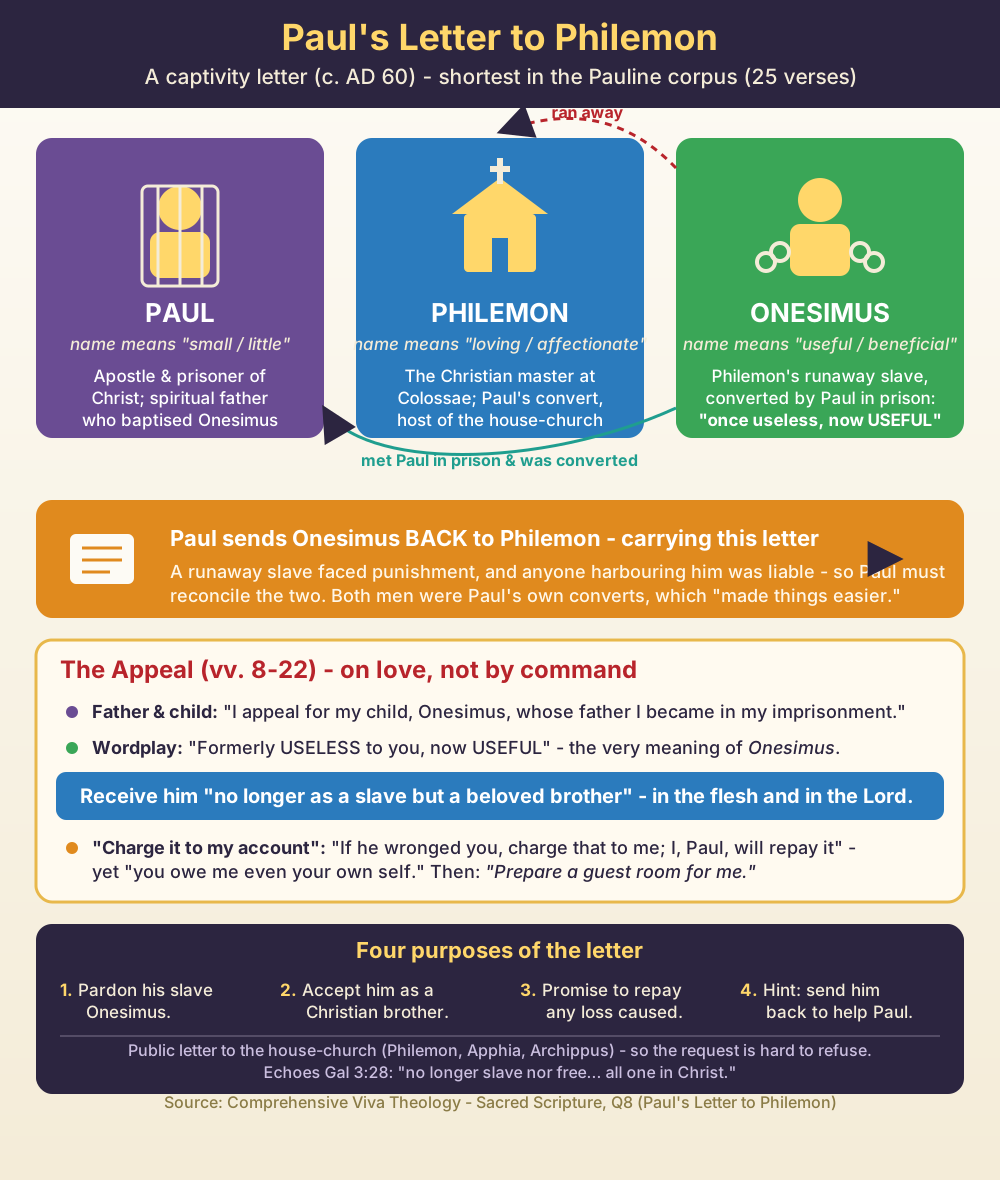
In short: Philemon is the shortest letter in the Pauline corpus (25 verses), an authentic (proto-Pauline) captivity letter. Its occasion: Onesimus, a runaway slave of Philemon, met Paul in prison and was converted; Paul now sends him back with an appeal (not a command) that Philemon receive him “no longer as a slave but a beloved brother.”
Sender, recipients, and the public character. Author: Paul, a prisoner of Jesus Christ; co-sender: Timothy (“our brother,” ὁ ἀδελφός). Recipients are Philemon, Apphia, Archippus, and the church in Philemon’s house: - Philemon — Paul’s convert and fellow-worker who lived in Colossae, one of the richest persons there; - Apphia — “the sister,” who may have been Philemon’s wife; - Archippus — “the fellow-soldier,” who may have been their son.
Because it is addressed publicly to the house-church, “the letter is not a private one.” Philemon must read it out, making Paul’s request known to all — which gently forces Philemon to grant it.
The three characters (with the meaning of their names — a wordplay the notes highlight):
| Person | Name means | Role |
|---|---|---|
| Paul | “small, little” | apostle, prisoner, spiritual father |
| Philemon | “loving, affectionate” | the master / wronged owner |
| Onesimus | “useful, beneficial” | the runaway slave, now converted |
Occasion. Onesimus ran away from Philemon, met Paul in prison, and was converted. A runaway slave was subject to punishment, and anyone harbouring him was also liable — so Paul had to solve the situation by getting Onesimus back to Philemon and reconciling the two. That both men were Paul’s own converts “made things easier.”
The four purposes: 1. To ask Philemon to pardon his slave Onesimus. 2. To request him to accept Onesimus as a Christian brother. 3. To promise repayment of any loss Onesimus caused. 4. To indirectly request that Onesimus be sent back to help Paul.
Structure:
| Verses | Section |
|---|---|
| 1-3 | Opening greetings (grace χάρις and peace εἰρήνη) |
| 4-7 | Thanksgiving (motivated by Philemon’s love and faith toward the Lord and the saints) |
| 8-22 | Apostolic request regarding Onesimus |
| 23-25 | Closing greetings |
The appeal (vv. 8-22) — Paul’s rhetoric. - Appeal vs. command (8-9): “though I am bold enough in Christ to command you… yet I would rather appeal on the basis of love — and I, Paul, do this as an old man, and now also as a prisoner of Christ Jesus.” - A father pleading for his child (10): “I am appealing to you for my child, Onesimus, whose father I have become during my imprisonment” — i.e. Paul baptised Onesimus while in prison/Rome. - The wordplay on “useful” (11): “Formerly he was useless to you, but now he is indeed useful (the very meaning of the name Onesimus) both to you and to me.” - “My own heart” (12): “I am sending him, that is, my own heart (τὰ ἐμὰ σπλάγχνα), back to you.” Paul preferred to do nothing without Philemon’s consent (14), so the good deed would be voluntary, not forced. - Brother, not slave (16): “no longer as a slave but more than a slave, a beloved brother (ἀδελφὸν ἀγαπητόν) — in the flesh and in the Lord” (ἐν σαρκὶ καὶ ἐν κυρίῳ = earthly and religiously). “Welcome him as you would welcome me” (17) — a theology of reconciliation and inclusion. - Promise of repayment (18-19): “If he has wronged you… charge that to my account. I, Paul, am writing this with my own hand: I will repay it” — adding the pointed reminder “I say nothing about your owing me even your own self” (Philemon owes Paul his very faith). - Wordplay again (20): “let me have this benefit (ὀνίνημι / oninēmi — a play on Onesimus) from you in the Lord! Refresh my heart in Christ,” confident of Philemon’s obedience (ὑπακοή). - Additional request (22): “Prepare a guest room for me,” hoping to be restored to them through their prayers.
Closing (23-25). Greetings from Epaphras (fellow prisoner) and Mark, Aristarchus, Demas, and Luke (fellow workers); final blessing of the grace (χάρις) of the Lord Jesus.
Semantic fields (the notes’ literary analysis). The letter weaves four vocabularies: business (partner, owe, charge to account, repay), friendship (love, beloved, splanchna = the heart/seat of feelings), prison (prisoner/imprisonment, vv. 1, 9, 10, 13, 23), and Jesus (Christ Jesus / Lord Jesus Christ / “in Christ,” “in the Lord”).
Key points: - Shortest Pauline letter (25 vv.); authentic captivity letter. - Public letter to a house-church, so the request is hard to refuse. - Onesimus = runaway slave, converted by Paul in prison; names mean Paul=little, Philemon=loving, Onesimus=useful. - Paul appeals on love, not commands; calls Onesimus “my child / my own heart.” - Asks reception “no longer as a slave but a beloved brother”; offers to repay, reminds Philemon he owes Paul “his own self.”
Connections: Philemon is the most personal application of Gal 3:28 (“no longer slave nor free… all one in Christ”) and complements the slaves/masters code of Eph 6:5-9 and Col 3:22-4:1 — there is one Master in heaven with no partiality. The motif of becoming “father” of a convert “in my imprisonment” echoes 1 Cor 4:15 (Paul as father through the Gospel). Reconciliation “in the flesh and in the Lord” is a living instance of the ministry of reconciliation (2 Cor 5:18-20).
Q9 — The theme of Parousia in 1 Thessalonians 4:13-5:13
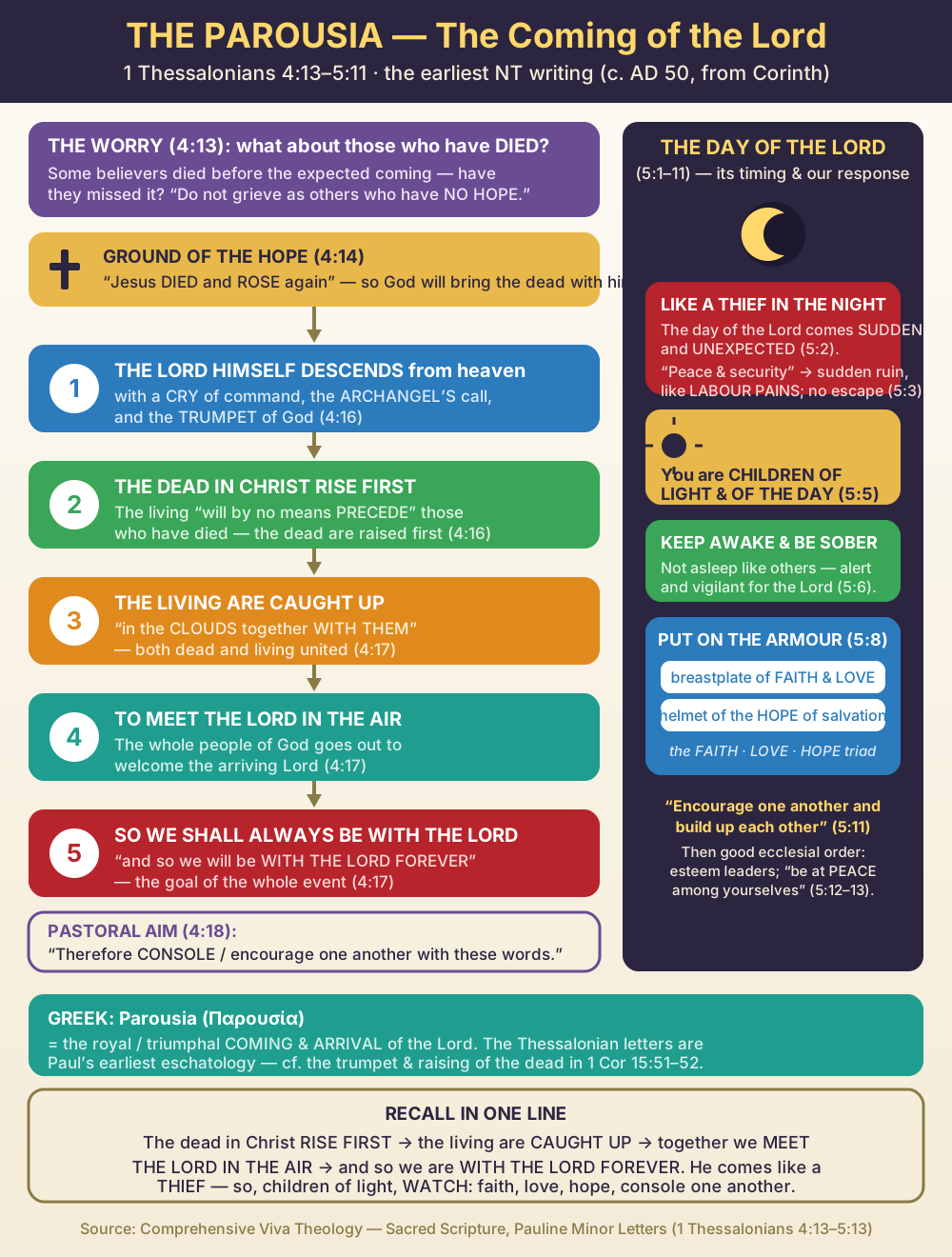
In short: 1 Thessalonians is the earliest New Testament writing (c. AD 50, written probably from Corinth), preceding the Gospels. Timothy brought Paul a worried question from Thessalonica about the Parousia (the Lord’s coming): some believers had died before the expected coming — had they missed it? Paul answers that the dead in Christ will rise first, the living will be caught up with them, “and so we will be with the Lord forever” — so they must not grieve “as others do who have no hope.”
Greek term. Parousia = the (royal/triumphal) coming/arrival of the Lord; the Thessalonian correspondence is the great Pauline text on it.
The occasion / pastoral problem. “There was a great anxiety among the Christians concerning Parousia. Paul and others taught them to wait for the coming of the Lord. But some Christians died before the expected Parousia, and the community was crying for those who died prematurely (ahead of time).” The driving questions: - How will the already dead participate in the Parousia? - Have they really missed the occasion?
Do not grieve without hope (4:13). “We do not want you to be uninformed… about those who have died, so that you may not grieve as others do who have no hope.” Christian mourning is real but hopeful — “do not cry as if there is no hope.”
The ground of the hope (4:14). The basis is the resurrection of Jesus: “since we believe that Jesus died and rose again, even so, through Jesus, God will bring with him those who have died.” The dead in Christ are not lost — their destiny is tied to the risen Christ.
The order and manner of the Parousia (4:15-17). “By the word of the Lord”: - “We who are alive… will by no means precede those who have died.” - “The Lord himself, with a cry of command, with the archangel’s call, and with the sound of God’s trumpet, will descend from heaven, and the dead in Christ will rise first.” - “Then we who are alive… will be caught up in the clouds together with them to meet the Lord in the air; and so we will be with the Lord forever.”
| Sequence of events at the Parousia (4:16-17) |
|---|
| 1. The Lord himself descends from heaven |
| 2. with a cry of command, the archangel’s call, and the trumpet of God |
| 3. the dead in Christ rise first |
| 4. the living are caught up in the clouds |
| 5. both meet the Lord in the air |
| 6. and are with the Lord forever |
Pastoral conclusion (4:18). “Therefore encourage one another with these words” — the doctrine is given for mutual consolation.
The timing — the Day of the Lord (5:1-3). “Concerning the times and the seasons… you do not need to have anything written.” Two images convey its character: - The thief in the night — “the day of the Lord will come like a thief in the night” (sudden, unexpected). - Labour pains on a pregnant woman — “when they say ‘There is peace and security,’ then sudden destruction comes… as labour pains come upon a pregnant woman, and there will be no escape.” The notes label this the inevitability and suddenness of the Parousia.
Watchfulness (5:4-11). Because Christians “belong to the day,” they must be awake, sober, and vigilant, not asleep like others: “put on the breastplate of faith and love, and for a helmet the hope of salvation” (5:8 — the faith–love–hope triad that runs through the whole letter). And again the consoling purpose: “encourage one another and build up each other.”
Good ecclesial living (5:12-13). Paul turns to community order: respect and esteem the leaders “who labour among you… and admonish you”; “be at peace among yourselves” (and on into 5:14-22: admonish the idlers, encourage the faint-hearted, help the weak, be patient, never repay evil for evil).
Key points: - 1 Thess = earliest NT writing, c. AD 50, likely from Corinth; occasioned by Timothy’s report. - Problem: believers died before the Parousia — did they miss out? - Ground of hope = Jesus’ death and resurrection (4:14). - Order: dead in Christ rise first, then living caught up — all “with the Lord forever.” - Timing unknown: thief in the night + labour pains = sudden, inescapable. - Response: watch, be sober, faith/love/hope, encourage one another.
Connections: This is Paul’s earliest eschatology; the same imminent-Parousia expectation shapes his advice in 1 Cor 7 (remain as you are “in view of the impending crisis / the appointed time has grown short”). The faith, love, hope triad (1 Thess 1:3; 5:8) is famously developed in 1 Cor 13:13. The “trumpet” and “raising of the dead” reappear in 1 Cor 15:51-52 (the resurrection body). Liturgically, the Parousia hope underlies the East-Syriac/Syro-Malabar Qurbana’s eschatological orientation — the Eucharist proclaiming the Lord’s death “until he comes” (cf. 1 Cor 11:26).
Q10 — The issues in Galatians and how Paul responds
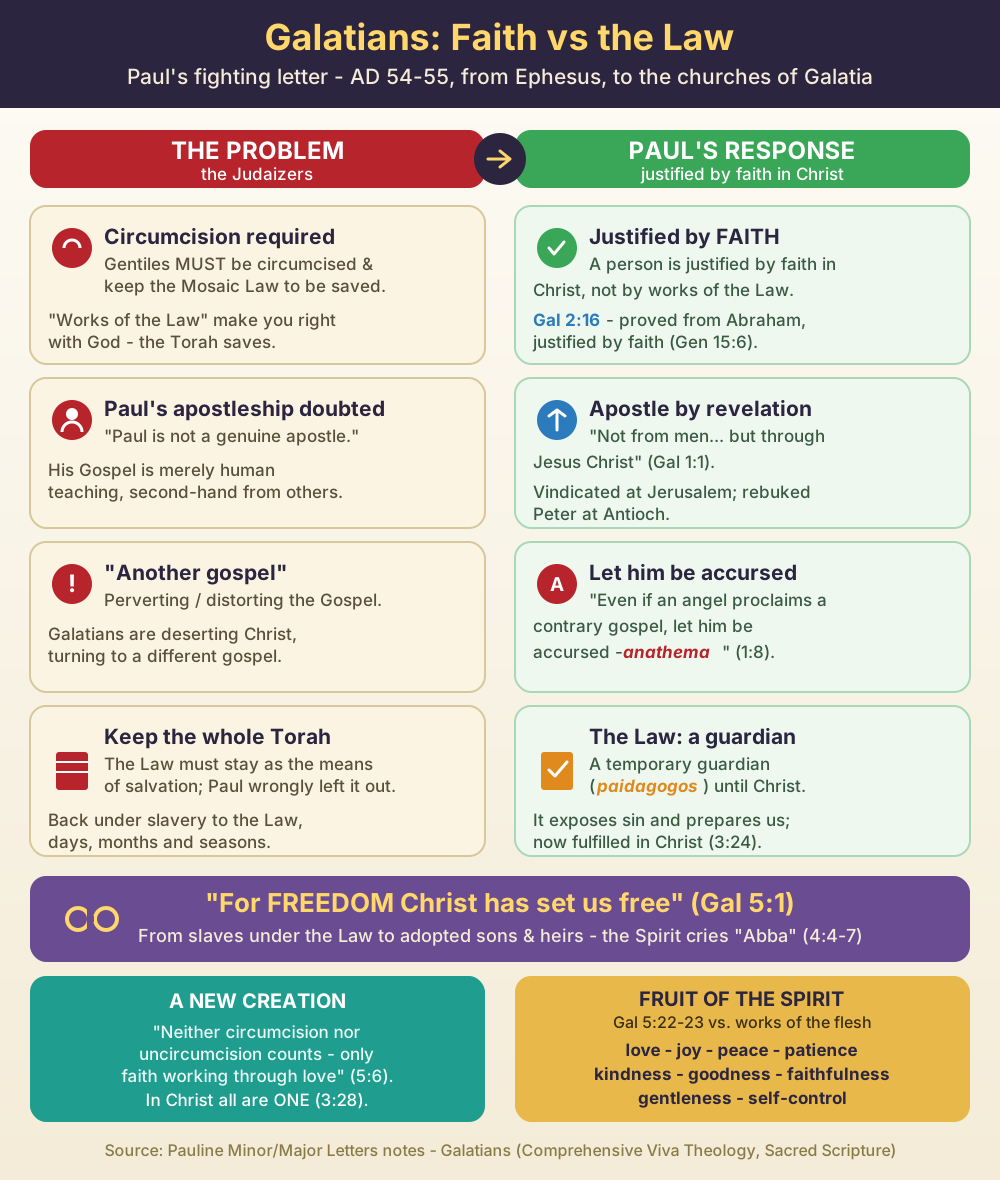
In short: Galatians (probable date AD 54-55, likely written from Ephesus, to “the churches of Galatia”) is Paul’s fighting letter against Judaizers who told Gentile converts they must be circumcised and keep the Torah to be saved, and who attacked Paul’s apostleship. Paul responds that he is a true apostle by direct revelation, that justification is by faith in Christ, not works of the Law, and that believers are free children/heirs of God — “for freedom Christ has set us free.”
The four issues (the notes’ own headings):
| Issue | The Judaizers’ claim | Paul’s response |
|---|---|---|
| Perverting the Gospel | False teachers taught against Paul’s Gospel | “Even if an angel… proclaim a contrary gospel, let him be accursed (ἀνάθεμα / anathema)” (1:8) |
| Circumcision | Circumcision is necessary for salvation | Circumcision is not necessary for salvation; what counts is faith working through love (5:6) |
| Apostleship of Paul | Paul is not a genuine apostle | Paul is an apostle “not from men… but through Jesus Christ” (1:1), by revelation |
| Embracing Torah | Paul left out the Torah as means of salvation | The Law is a temporary guardian, fulfilled in Christ; justification is by faith |
1. Defence of the Gospel (1:6-10). Paul names three faults of the Galatians: they are deserting Jesus, turning away from the Gospel, and following a different gospel. His rhetoric is fierce: “even if we or an angel from heaven proclaim a gospel contrary… let that one be accursed (anathema)” — a strong rhetorical mode, since an angel would never preach against the true Gospel.
2. Defence of his apostleship (1:11-24; 2:1-14). - His Gospel is “not of human origin… I did not receive it from a human source, I was not taught it; I received it through a revelation of Jesus Christ.” - He recounts his past in Judaism (violently persecuting and trying to destroy the Church, zealous for ancestral traditions) and his call through God’s grace — owing nothing to other humans, “not even other apostles.” - Recognition at Jerusalem (2:1-10): after 14 years he met the leaders; did not circumcise Titus, a Greek; the “pillars” James, Peter, and John accepted his stand and extended fellowship (κοινωνία), agreeing Paul was entrusted with the Gentiles and Peter with the Jews (he was only asked to “remember the poor”). - Confrontation with Peter at Antioch (2:11-14): Paul publicly rebukes Peter’s inconsistent behaviour (ὑπόκρισις / hupokrisis = hypocrisy, pretence) — proof of Paul’s authority among the apostles in the very area where it was questioned.
3. Justification by faith (2:15-3:29) — the heart of the letter. The notes lay out the four “justification” positions:
| Justification / salvation by… | Held by |
|---|---|
| Faith in Jesus Christ | Paul |
| Law / Torah / circumcision | the Jews |
| Works of charity (faith expressed in love) | James |
| Grace of the Lord (Acts 15:11) | Peter |
- Argument from Scripture (3:6-14): Abraham was justified by faith (Gen 15:6), and “in Abraham all nations would be blessed” (Gen 12:3); those who rely on the works of the Law are under a curse (Deut 27:26); but Christ redeemed us from the curse of the Law (3:13), so Abraham’s blessing reaches the Gentiles through Christ.
- Purpose of the Law (3:21-24): the Law is not opposed to God’s promises; it exposes human sinfulness (“all imprisoned under sin”), acted as a guardian (παιδαγωγός), and prepares us for Christ — “the Law was a temporary measure.”
- Unity and identity in Christ (3:26-29): children of God through faith; baptism clothes us with Christ; “all are one in Christ” (the equality of Gal 3:28); and so heirs of the promise.
4. Christian freedom (chap. 4-5). - From slavery to sonship (4:1-7): an heir who is a child is no better than a slave under guardians; but “when the fullness of time came, God sent forth his Son, born of a woman, born under the Law, to redeem those under the Law, so that we might receive adoption as sons” — and the Spirit makes us cry “Abba.” Believers move from slaves under the Law to adopted children and heirs. - Moral exhortation (5:1-6:10): Paul sums it up in 5:1 (freedom in Christ); “neither circumcision nor uncircumcision counts for anything; the only thing is faith working through love” (5:6 — the notes link this to the circumcision of the heart: Deut 30:6; 1 Cor 7:19; Rom 3:30). - Works of the flesh vs. fruits of the Spirit (5:19-23): the works of the flesh (immorality, idolatry, hatred, divisions, drunkenness, etc.) “will not inherit the kingdom of God”; the fruit of the Spirit — love, joy, peace, patience, kindness, goodness, faithfulness, gentleness, self-control — belongs to those who will. Community life (6:1-10): restore gently, bear one another’s burdens, sow to the Spirit, do good to all.
Key points: - Four issues: perverting the Gospel, circumcision, Paul’s apostleship, embracing Torah. - Paul’s Gospel is by revelation, not human teaching; apostleship vindicated at Jerusalem and at Antioch (rebuking Peter). - Central doctrine: justification by faith, proved from Abraham (Gen 15:6) and the curse of the Law (Deut 27:26; Gal 3:13). - Law = temporary guardian preparing for Christ; in Christ all are one (3:28), adopted sons and heirs. - Ethics: freedom, “faith working through love” (5:6), fruit of the Spirit vs. works of the flesh.
Connections: Galatians is the polemical twin of Romans (justification by faith, Abraham as model, the curse/role of the Law). The Jerusalem Council (Acts 15) settles the same circumcision question (“we are saved through the grace of the Lord Jesus,” Acts 15:11). “Faith working through love” bridges Paul and James (faith expressed in charity). The adoption/Spirit theme (4:4-7, “Abba”) feeds Trinitarian and grace theology (the Son sent in the fullness of time; the Spirit of sonship).
Q11 — Contexts and purposes of 1 Corinthians, and exegesis of 1 Cor 1:10-17
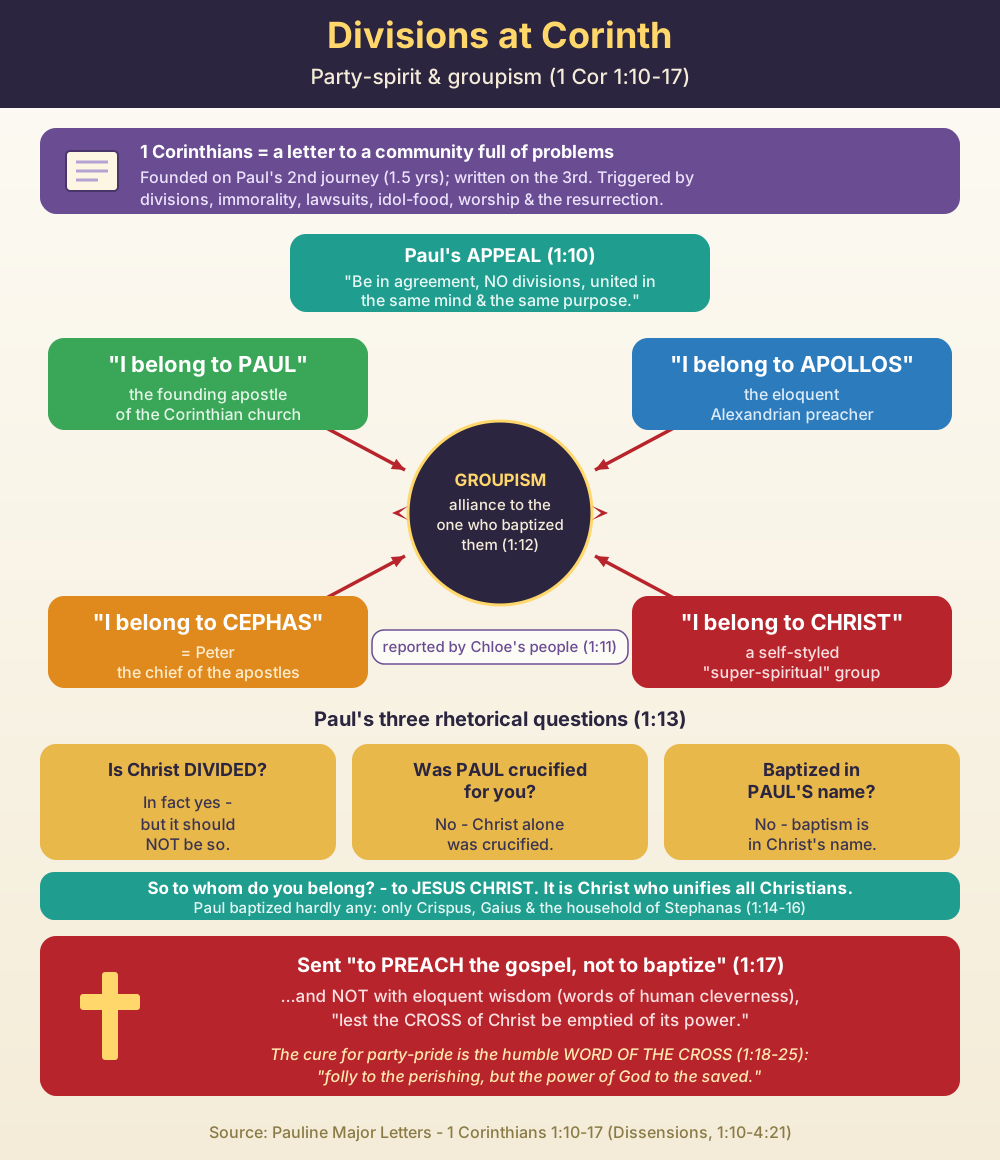
In short: Paul founded the Corinthian church on his second missionary journey (about 1½ years at Corinth) and wrote 1 Corinthians during his third journey to answer (a) reports of factionalism (σχίσματα) he had heard, and (b) a list of practical questions the Corinthians had written to him. The opening problem (1:10-17) is party-spirit / groupism: members were saying “I belong to Paul / Apollos / Cephas / Christ,” to which Paul replies that Christ is not divided and that he was sent “not to baptize but to preach the gospel” — lest the cross of Christ be emptied.
Contexts and purposes. Two trigger-texts in the notes: - 1 Cor 1:10-11 — the context of factionalism (σχίσματα) in the community (reported to Paul by Chloe’s people — “Chloe was a well-to-do Christian disciple and a church leader”). - 1 Cor 7:1 — the “puzzling problems concerning the life of Christians in Corinth that required assistance” (the matters they wrote about: marriage/celibacy, food offered to idols, worship, spiritual gifts, the resurrection).
Corinth itself was a notoriously immoral port-city, which colours the later chapters (sexual immorality, lawsuits, idol-food, abuses at the Lord’s Supper, rivalry over showy gifts like tongues). The letter’s outline runs: Introduction (1:1-9) → Dissensions (1:10-4:21) → Moral problems (5-6) → Marriage & celibacy (7) → Idol-food (8-10) → Worship, gifts, love (11-14) → Resurrection (15) → Greetings (16).
Exegesis of 1 Cor 1:10-17:
(a) The appeal for unity (1:10). Paul “makes an appeal to be in agreement, that there be no divisions, and that they be united in the same mind and the same purpose.” This sets the agenda for chapters 1-4.
(b) The reason for the quarrel (1:12) — “groupism.” “Corinthian Christians declared their alliance to a member from whom they received baptism”: “I belong to Paul, or I belong to Apollos, or I belong to Cephas, or I belong to Christ.” “With these claims they show their superiority over others.” The slogans turned the ministers who baptised them into rival party-banners.
| Slogan | Implied “party leader” |
|---|---|
| “I belong to Paul” | the founding apostle |
| “I belong to Apollos” | the eloquent Alexandrian preacher |
| “I belong to Cephas” | Peter |
| “I belong to Christ” | a (self-styled super-spiritual) group |
(c) Paul’s solution — three rhetorical questions (1:13). Paul “tries to convince them that it is Christ who is important, and not the one who baptized them,” by asking: - “Is Christ divided?” — Yes (in fact), but it should not be so. - “Was Paul crucified for you?” — No. - “Or were you baptized in the name of Paul?” — No.
The point: “Then to whom do you belong? — Jesus Christ. It is Christ who unifies all Christians.” Allegiance is to the crucified Christ, not to the human minister.
(d) “I baptized hardly any of you” (1:14-16). Paul recalls baptizing only Crispus and Gaius, and the household of Stephanas — precisely so that no one could say they were baptized in his name, and so that baptism is not turned into a party-label.
(e) Sent to preach, not to baptize (1:17). “Christ did not send me to baptize but to proclaim the gospel — and not with eloquent wisdom (words of human cleverness), so that the cross of Christ might not be emptied of its power.” This pivots straight into the theology of the cross as folly and power (1:18-25): “the cross is foolishness to those perishing, but the power of God to those being saved” — so the cure for party-pride is the humble word of the cross, and “let the one who boasts, boast in the Lord” (1:31).
Key points: - Founded on the 2nd journey (1½ years); written on the 3rd. - Two contexts: factionalism (1:10-11, via Chloe’s people) and written questions (7:1). - 1:10 = appeal for unity; 1:12 = slogans “I belong to Paul/Apollos/Cephas/Christ” = groupism by baptizer. - 1:13 = three questions (Is Christ divided? Was Paul crucified for you? Were you baptized in Paul’s name?) → answer: belong to Christ. - 1:14-16 = Paul baptized only Crispus, Gaius, household of Stephanas. - 1:17 = sent to preach, not baptize, lest the cross be emptied → the word of the cross (1:18-25) heals division.
Connections: The unity argument is developed later with the one body, many members image (1 Cor 12) and the hymn of love (1 Cor 13) — diversity of gifts for the common good, not for rivalry; the same Greek σχίσματα (schismata) that names the parties here reappears for the divisions at the Lord’s Supper (11:18). The “not with eloquent wisdom” of 1:17 anticipates Paul’s whole theology of the cross versus worldly sophia. Ecclesiologically this anchors the Church’s oneness (cf. Eph 4:4-6, “one body, one Lord, one faith, one baptism”) and the principle that the minister of a sacrament acts in the name of Christ, not his own.
Q12 — The immoral issues and law-suits at Corinth (1 Cor 5:1-6:20): incest, pagan courts, “your body is a temple of the Holy Spirit”
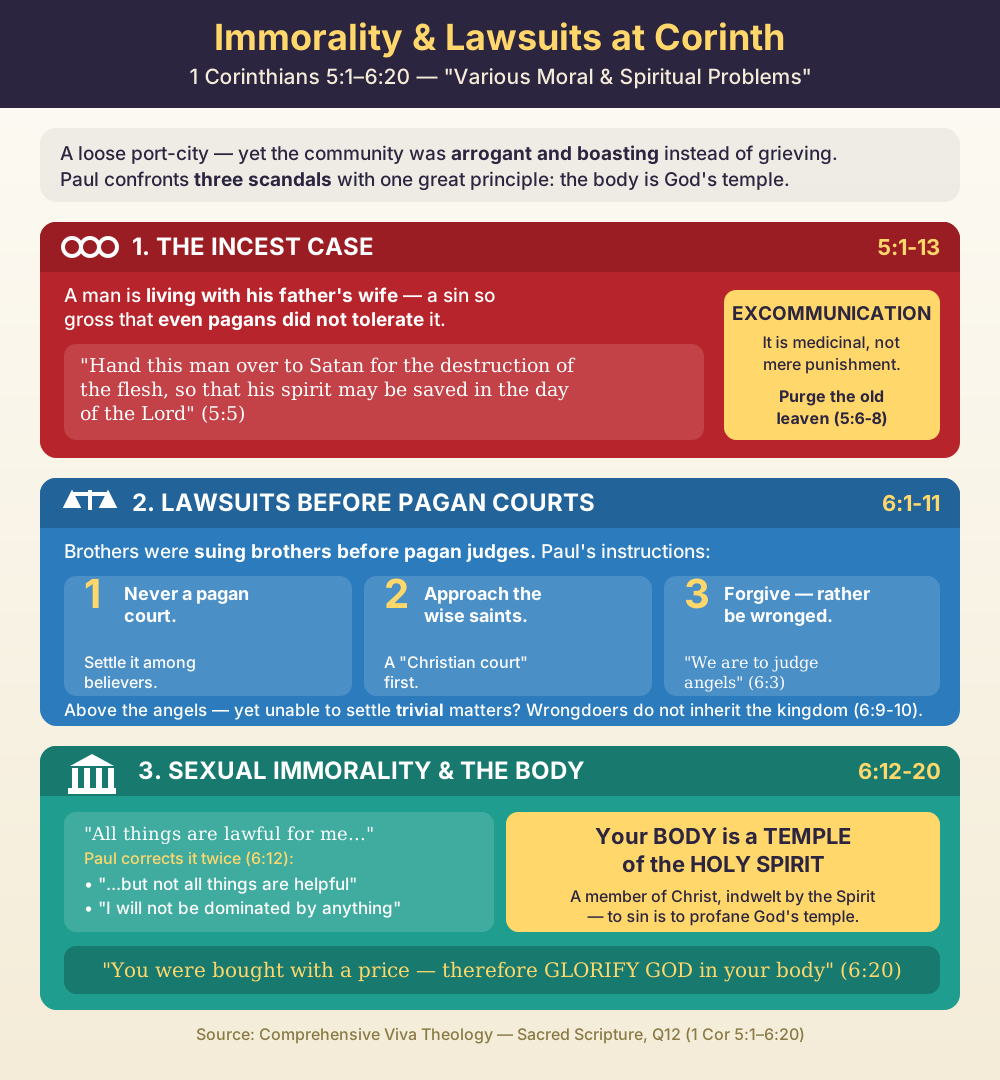
In short: Under the heading “Various Moral and Spiritual Problems in the Congregation” (5:1–6:20), Paul deals with three scandals in a sexually loose port-city: a case of incest (a man living with his father’s wife), Christians suing one another in pagan courts, and the abuse of the body through sexual immorality — answered with the great principle that the body is a temple of the Holy Spirit.
Corinth was a notoriously immoral city, and the worst part is that the community was arrogant and boasting instead of grieving. Paul lists the major immoral aberrations: sexual immorality (porneia), a man living with his father’s wife, arrogance and boasting, malice and evil, lack of sincerity and truth, association with the immoral, the greedy, robbers, idolaters, revilers and drunkards.
(1) The case of incest (5:1-13). A man “is living with his father’s wife” — a sin so gross that even pagans did not tolerate it. Paul’s verdict: “You are to hand this man over to Satan for the destruction of the flesh, so that his spirit may be saved in the day of the Lord” (5:5). This is excommunication: the offender is deprived of the support of God’s people and of the Church. The note explains the theology behind it — in the Church there is the presence of God; outside, in the world, there is the absence of God and the presence of Satan (Satanas = the Adversary, the enemy of God and his people). The punishment is therefore medicinal — handing over to Satan now so the spirit may be saved at the end. Paul also clarifies (5:9-13) that he means non-association with an immoral person inside the Church, not a withdrawal from the immoral of the outside world (otherwise one would have to leave the world altogether).
(2) Law-suits before pagan courts (6:1-11). Christians were dragging each other before pagan judges. Paul’s instructions: - Never go to a pagan court. - Approach the wise saints first — the “Christian court.” - Forgive the other (better to be wronged than to scandalize).
He argues ironically and from dignity: “Do you not know that we are to judge angels?” (6:3). Since the Christian lives with Jesus, he is above the angels; it is shameful that such people cannot settle trivial earthly matters among themselves and run instead to outsiders. He warns that wrongdoers will not inherit the kingdom of God (6:9-10).
(3) Immorality and the body — “your body is a temple of the Holy Spirit” (6:12-20). Paul takes up a Corinthian slogan, “All things are lawful for me,” and corrects it twice: “but not all things are beneficial… I will not be dominated by anything” (6:12). The body is not meant for immoral purposes because it is the temple of the Holy Spirit. Sexual immorality of Christians affects their belongingness to Christ — the believer’s body is a member of Christ and indwelt by the Spirit, so to sin sexually is to profane God’s temple.
Key points: - 5:1–6:20 = the section “Various Moral and Spiritual Problems.” - Incest (5:1) → hand over to Satan (5:5) = excommunication, medicinal, “spirit saved in the day of the Lord.” - Kakos = evil/bad; poneria = wickedness/malice; Satanas = the Adversary. - Law-suits (6:1-11): never a pagan court → Christian court → forgive; “we are to judge angels” (6:3); wrongdoers do not inherit the kingdom (6:9-10). - Body as temple of the Holy Spirit (6:12-20); two limits on “all things are lawful.”
| Issue | Text | Paul’s response |
|---|---|---|
| Incest (father’s wife) | 5:1-13 | Hand over to Satan (5:5); excommunicate; “spirit saved in the day of the Lord” |
| Law-suits | 6:1-11 | No pagan courts; use the saints; forgive; “we judge angels” (6:3) |
| Sexual immorality / the body | 6:12-20 | Body = temple of the Holy Spirit; member of Christ; do not be dominated |
Connections: “Temple of the Holy Spirit” links to pneumatology and to 1 Cor 3:16-17 (the community as God’s temple); the same phrase grounds the Catholic theology of the body and chastity. The phrase “all things are lawful but not all build up” returns at 10:23. “Hand over to Satan” anticipates the Church’s discipline of excommunication as healing, not mere punishment.
Q13 — Paul’s teaching on Spiritual Gifts (1 Cor 12 and 14): charisms, one body many members, the ordering of tongues and prophecy
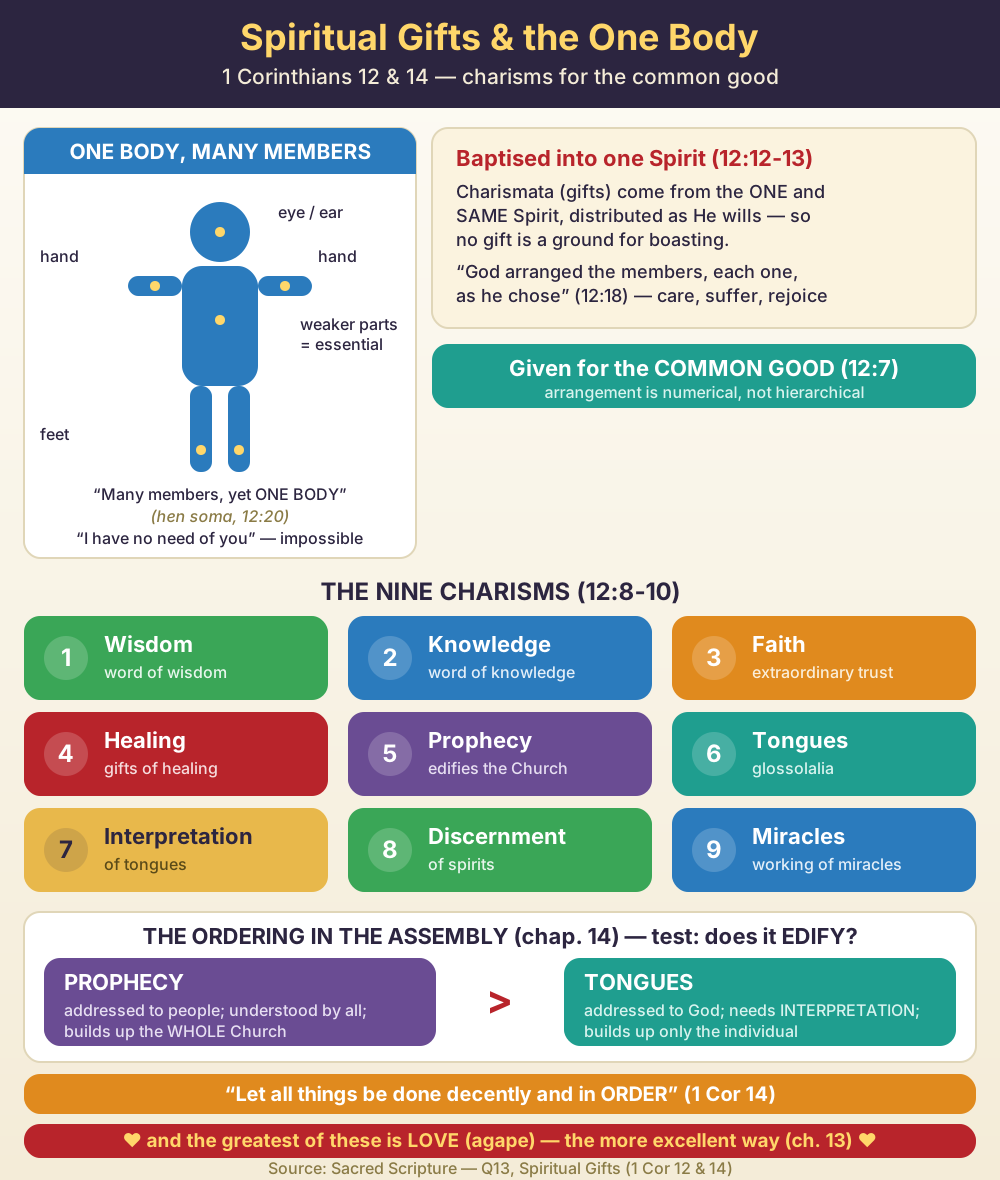
In short: Spiritual gifts (charismata) are given by the one and same Spirit for the common good; the community is one body with many members, each indispensable; and because gifts are for building up the Church, the gift that everyone can understand — prophecy — is ranked above unintelligible tongues, with love (chap. 13) as the “more excellent way” that gives all gifts their value.
Context. In Corinth there was a “system of exoteric speech,” and the pagan-converted Christians regarded the gift of tongues as greater than all other gifts. This pride led to divisions in the community. Paul corrects them.
Key Greek terms: Pneumatikos = spiritual (gifts); Charisma = gift; glossolalia = speaking in tongues; agape = love.
The nine gifts. The note lists nine types of gifts:
| # | Gift | # | Gift |
|---|---|---|---|
| 1 | Wisdom | 6 | Speaking in Tongues (glossolalia) |
| 2 | Knowledge | 7 | Interpretation of Tongues |
| 3 | Faith | 8 | Discernment (of spirits) |
| 4 | Healing | 9 | Miracle (working of miracles) |
| 5 | Prophecy |
Paul’s teaching (chap. 12). - Use the diversity of gifts for the common good (12:7). - One and the same Spirit distributes all gifts according to His will — so no gift is a ground for boasting.
Analogy of one body and many parts (12:12-27): Body = the Church; organs = the gifts. - Every organ is equally important; “God arranged the members in the body, each one of them, as he chose” (12:18). - “There are many members, yet one body (hen soma)” (12:20). - Nobody can say to another, “I have no need of you”; all are mutually related, nobody independent. - The seemingly weaker members are essential; all are honourable; there must be no dissension in the body; all must care for one another, suffer with the suffering and rejoice with the joyful.
Various functions and unity: God has appointed different functions (12:28). This is not a hierarchical ranking but only a numerical arrangement (so tongues, which they prized, comes last). Paul then points beyond all gifts to an excellent way — love — for exercising every other gift.
The Hymn of Love (chap. 13) is the hinge between chapters 12 and 14. The Greek has four words for love — Eros (romantic), Storge (family), Philia (friendship), Agape (unconditional, God’s love). Structure: (i) gifts are worthless without love (vv.1-3: without love “I am a nuisance, I am nothing, I gain nothing”); (ii) qualities of love (vv.4-8: patient, kind, protects, trusts, hopes, perseveres; not envious, boastful, proud, rude, self-seeking, easily angered, keeps no record of wrongs); (iii) love is permanent — it “remains forever” (vv.9-13), unlike tongues and prophecy which will pass.
The ordering of tongues and prophecy (chap. 14). Paul measures gifts by whether they edify the Church:
| Gift of Tongues (14) | Gift of Prophecy (14) | |
|---|---|---|
| Addressed to | God (14:2) | Men/people |
| Understood by | Not normally by speaker or hearers (14:2) | Both speaker and hearer |
| Nature | Inspired utterance; praise and adoration (14:2,16) | Edifies the Church |
| Control | Under the speaker’s control, not involuntary (14:28) | — |
| Value to assembly | Builds up only the individual unless interpreted | Builds up the whole Church |
Because the criterion is edification, Paul ranks prophecy above tongues in the assembly: tongues need an interpreter to profit others, while prophecy is understood by all and builds up the Church.
Key points: - Gifts from one Spirit, for the common good (12:7), distributed as He wills. - Nine gifts; arrangement numerical not hierarchical (tongues last). - One body, many members — all indispensable (12:12-27). - Love (chap. 13) = the “more excellent way”; permanent when gifts cease. - Prophecy > tongues in the assembly because it is intelligible and edifies.
Connections: “One body, many members” is Paul’s great image of the Church as the Body of Christ (cf. Rom 12:4-8; Eph 4; Col 1:18) and undergirds the theology of diversity-in-unity and the communion of the Church. The trinitarian shape — one Spirit, one Lord, one God working all in all — links to pneumatology and Trinitarian theology. The primacy of agape over charisms anchors the spiritual-discernment tradition of the Fathers.
Q14 — Paul’s vision on food offered to idols (1 Cor 8 and 10): knowledge vs love, conscience of the weak, idolatry
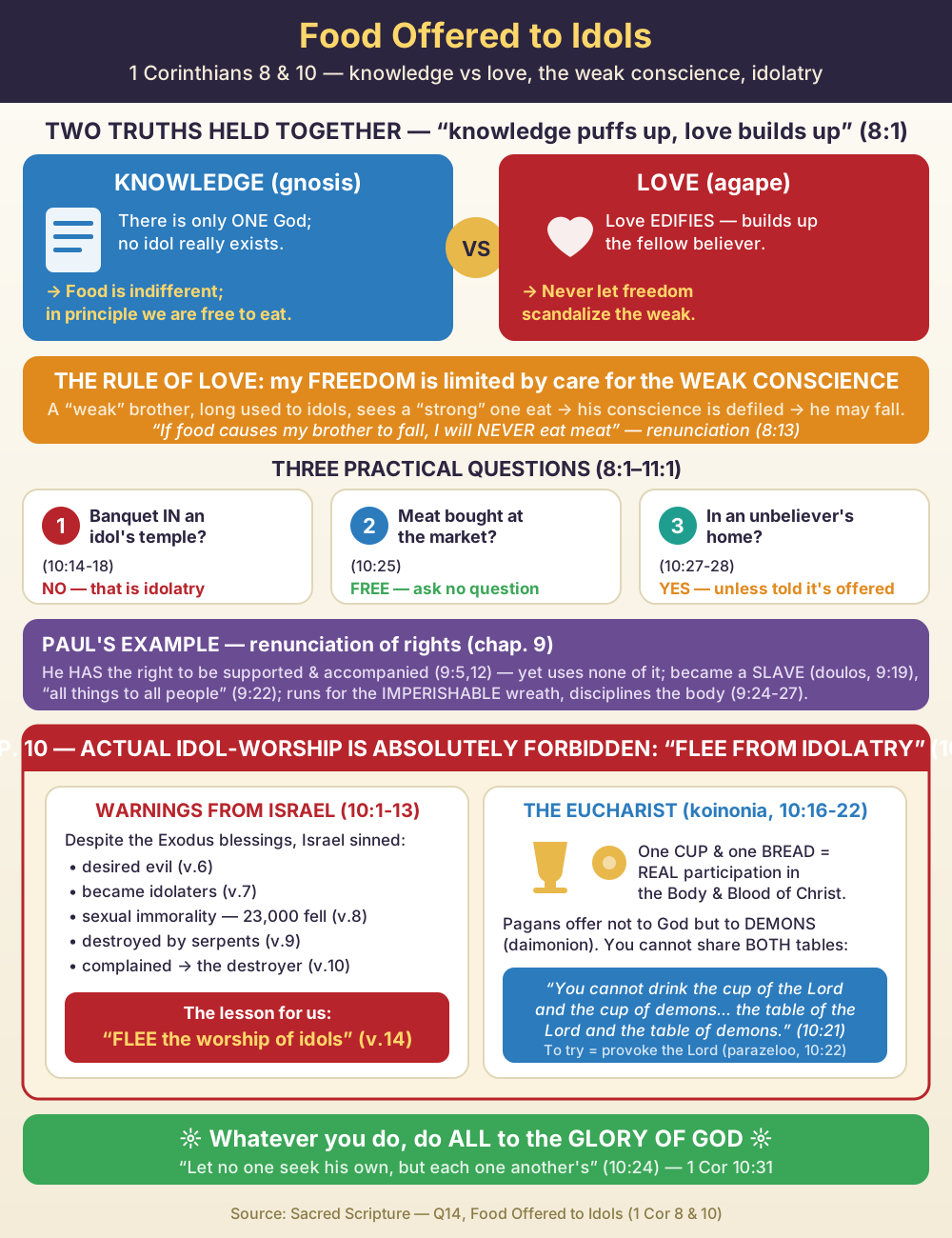
In short: On the question of meat sacrificed to idols, Paul holds two truths together: “knowledge” says idols are nothing and so the food is indifferent, but “love” says one must never let one’s freedom scandalize the weak conscience of a fellow Christian — and, when it comes to actually sharing in pagan worship, that is idolatry and absolutely forbidden.
The three practical questions (8:1–11:1): 1. Could a Christian attend a banquet in an idol’s temple (10:14-18)? 2. Could a Christian eat meat sacrificed to idols that he bought at the market (10:25)? 3. Could a Christian eat such meat in the home of an unbelieving friend (10:27-28)?
Paul’s answer — knowledge vs. love (chap. 8). The key verse: “Knowledge (gnosis) puffs up, but love (agape) edifies / builds up” (8:1). - Our knowledge: there is only one God; no idol really exists. So in principle we are free to eat anything. - But the weak conscience: some, long accustomed to idols, still think of the food as offered to an idol; their conscience, being weak, is defiled. When such a “weak” Gentile Christian sees a “strong” Christian (one with knowledge) eating, it becomes a scandal and may make him fall. - Therefore — the rule of love: one must consider the weak conscience of the fellow Christian. Paul’s own resolution: “if food is a cause of their falling, I will never eat meat” — renunciation — “so that I may not cause one of them to fall” (8:13). Love limits the use of a real freedom.
Paul’s example — renunciation of rights (chap. 9). To model this, Paul gives up his own rights. The Corinthians are “the seal of my apostleship” (9:2 — seal = his authority over them), though some questioned his apostleship (9:3). He has the right to be supported (the soldier, the vineyard-planter, the shepherd; the Law of Moses, Deut 25:4 in 9:9; Jesus’ own teaching, Mt 10:10 in 9:14) and the right to be accompanied by a believing woman (9:5). Yet he uses none of it (9:12), preaching the Gospel as a duty and a stewardship (9:16-17): he made himself a slave (doulos, 9:19) and “became all things to all people” (9:22). He ends with the athletic imagery (9:24-27): run to win, exercise self-control, race for an imperishable wreath, discipline the body.
Warning against idolatry (chap. 10). - From history (10:1-13): despite God’s blessings in the Exodus, Israel sinned — they desired evil (v.6), became idolaters (v.7), fell into sexual immorality (v.8), and complained (v.10). The results: 23,000 fell in one day (v.8), destroyed by serpents (v.9) and by the destroyer (v.10). The lesson: “flee from the worship of idols” (v.14). - From the Eucharist (10:16-22): through the koinonia in the one bread and one cup we become one with Jesus Christ — not a mere social fellowship but a real participation in the body and blood of Christ, bringing the believer into a new mode of existence. By contrast, pagans offer not to God but to demons (daimonion; Satan = Godlessness, the absence of God). Hence: “You cannot drink the cup of the Lord and the cup of demons; you cannot partake of the table of the Lord and the table of demons.” The “strong” Corinthian faces this dilemma — he cannot share both tables. To try is to provoke the Lord’s anger (parazeloo, 10:22). - The summing-up (10:23-24): the slogan again — “All things are lawful, but not all things build up” (= 6:12) — and the principle: “Let no one seek his own advantage, but each one another’s” (10:24).
Key points: - 8:1 — knowledge puffs up, love builds up. - Idols are nothing → food is indifferent in itself. - But the weak conscience must not be scandalized → renounce the right (8:13). - Chap. 9 — Paul models renunciation of rights. - Chap. 10 — actual idol-worship is forbidden: Israel’s history + the Eucharist argument (cannot share both tables).
| Principle | Chapter | Saying |
|---|---|---|
| Knowledge | 8 | Idols are nothing; food is free |
| Love / conscience | 8 | Do not scandalize the weak; “I will never eat meat” (8:13) |
| Renunciation of rights | 9 | Became a slave to all; imperishable wreath |
| Idolatry forbidden | 10 | “Flee idolatry” (10:14); cannot share both tables (10:21) |
Connections: The Eucharist argument (10:16-17, koinonia in one bread → one body) feeds directly into chap. 11 and into Eucharistic theology and the East-Syriac understanding of the Qurbana as real participation in the Body and Blood. “Knowledge vs. love” is a perennial principle of moral theology (the rights of the weak conscience, avoidance of scandal). Paul’s “becoming all things to all” is a model of missionary inculturation.
Q15 — Paul’s teaching on Marriage and Celibacy (1 Cor 7)
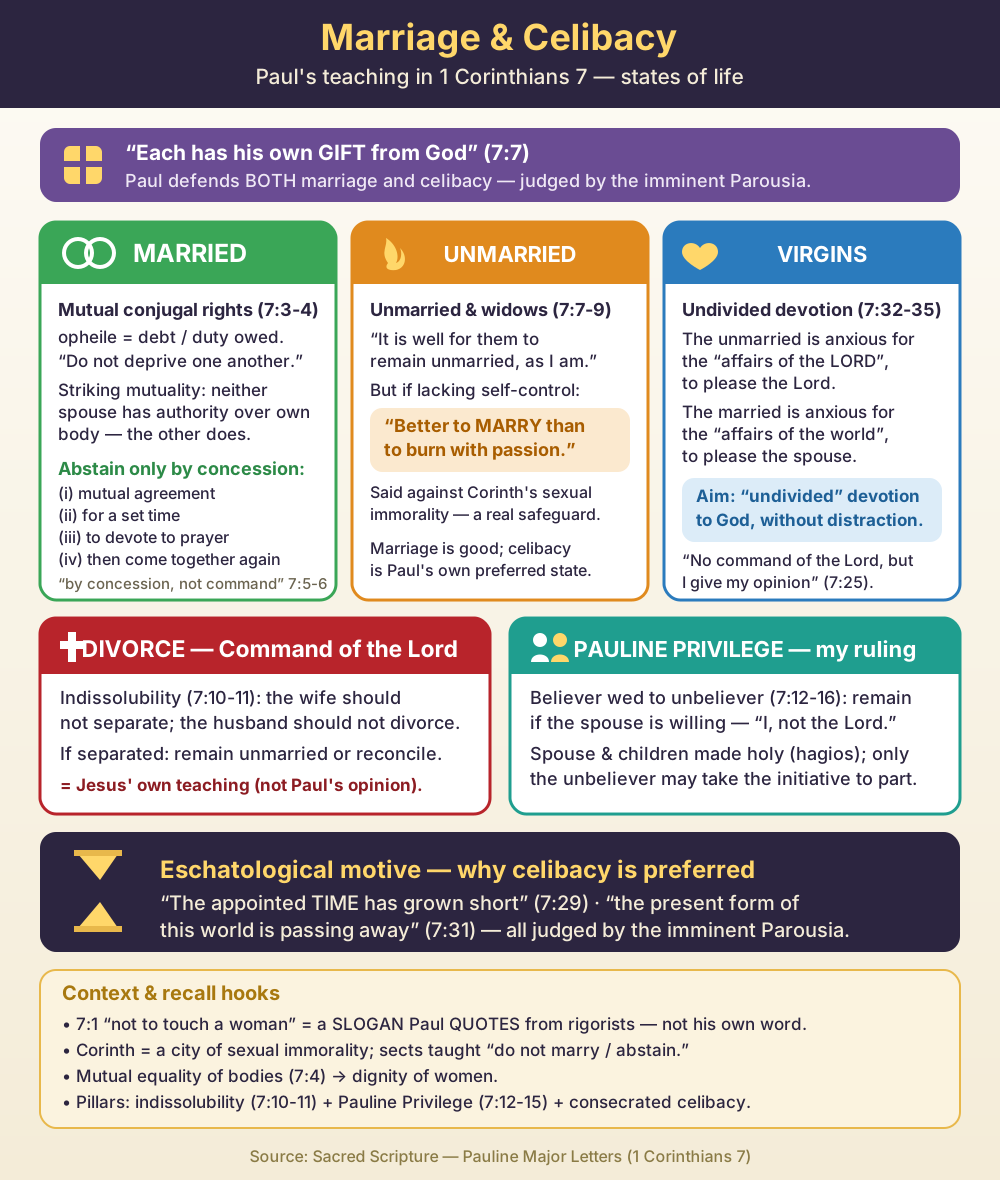
In short: Writing into a sexually immoral city against rigorists who said married couples should renounce sexual relations, Paul defends both marriage (with its mutual conjugal duties and indissolubility) and celibacy (his own preferred state) — judging everything in the light of the imminent Parousia (“the appointed time has grown short”).
Context. Corinth was a place of sexual immorality, and there were sects claiming “do not marry, and if married, abstain from sexual relations.” The chapter opens by quoting their slogan: “It is well for a man not to touch a woman” (7:1). The note stresses: this is not Paul’s word — he is citing what they wrote to him, and then qualifies it.
Key term: opheile = debt, obligation, duty, conjugal rights (7:3).
Duty of husband and wife (7:3-4). The husband must give his wife her conjugal rights, and the wife likewise. “The wife does not have authority over her own body, but the husband does; likewise the husband does not have authority over his own body, but the wife does.” — a striking mutuality and equality.
The Pauline Concession (7:5-6). Couples may abstain only under four conditions: (i) by mutual agreement, (ii) for a set time, (iii) to devote themselves to prayer, (iv) and then come together again. Paul gives this by way of concession, not of command.
To the unmarried and widows (7:7-9). Paul: “it is well for them to remain unmarried as I am” (in the context of the imminent Parousia; cf. 7:17; Eph 4:1). But “if they are not practicing self-control, they should marry, for it is better to marry than to be aflame with passion” — said in the context of Corinth’s sexual immorality.
Divorce (7:10-11). Here Paul gives a command of the Lord (not his own): the wife should not separate from her husband (but if she does, let her remain unmarried or be reconciled), and the husband should not divorce his wife. This is Jesus’ teaching on indissolubility.
The Pauline Privilege — believer married to unbeliever (7:12-16). Here Paul gives his own ruling (“I, not the Lord”). Such a union is not a sacramental marriage but a case of disparity of cult; when the unbeliever is baptized it becomes sacramentally valid. The believer must not initiate separation — “the unbelieving husband is made holy through his wife, and the unbelieving wife through her husband” (v.14); otherwise the children would be unclean (akathartos = impure, separated from God), “but as it is, they are holy” (hagios = set apart for God). Only the unbeliever may take the initiative to separate (v.15).
About virgins (7:25-31). “I have no command of the Lord, but I give my opinion as one who… is trustworthy.” In view of the impending crisis it is well to remain as one is — because of the hope of the immediate Parousia: “the appointed time has grown short” (v.29) and “the present form of this world is passing away” (v.31). (anagke = necessity, 7:37; distress/calamity, 7:26.)
Advantage of unmarried over married (7:32-35):
| Married man / woman | Unmarried man / woman | |
|---|---|---|
| Concern | The affairs of the world | The affairs of the Lord |
| Aim to please | Wife / husband | The Lord (to devote oneself to God) |
Key points: - 7:1 is a quoted slogan, not Paul’s own view. - Marriage: mutual conjugal duties (7:3-4); abstinence only by the 4-fold concession (7:5-6). - Divorce: indissolubility — a command of the Lord (7:10-11). - Pauline Privilege: mixed marriage, disparity of cult; only the unbeliever may initiate separation (7:12-16). - Celibacy preferred — but always relative to the imminent Parousia; “better to marry than to burn.”
Connections: 7:10-11 is one of the NT pillars of the Catholic doctrine of the indissolubility of marriage (with the Pauline Privilege of 7:12-15 a recognized ground for dissolution of a natural, non-sacramental bond). The eschatological motive (“time grown short”) roots consecrated celibacy and the priestly/religious life in the expectation of the Kingdom. Paul’s equal mutuality of bodies (7:4) is notable for its dignity of women.
Q16 — The Lord’s Supper in 1 Cor 11 (the tradition received, abuses at the assembly, “discerning the body”)
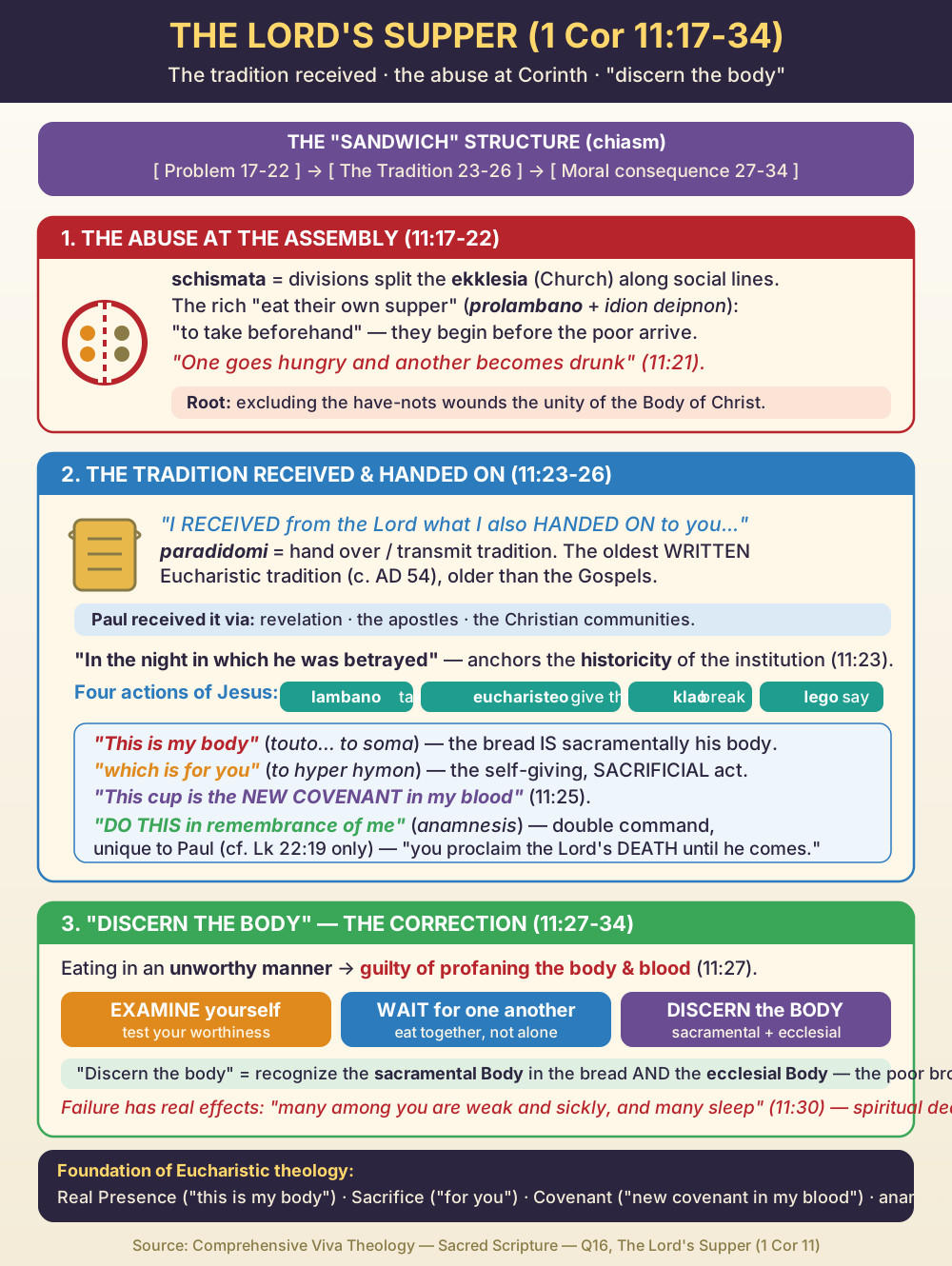
In short: At the Corinthian assembly the rich were “eating their own supper” before the poor arrived, so the common meal split the Body of Christ along social lines. Paul rebukes them, then quotes the oldest written Eucharistic tradition he himself “received” and “handed on,” and demands that they examine themselves and “discern the body.”
The passage (11:17-34) is built on a “sandwich” model: [problem 17-22] – [the tradition 23-26] – [moral consequence 27-34].
(1) The problem — abuses at the assembly (11:17-22). Key terms: ekklesia = Church; schismata = divisions; prolambano = “to take beforehand,” joined with idion deipnon = “eating his own supper.” The result: “one goes hungry and another becomes drunk.” The root reason: the exclusion of the have-nots hinders the unity of the Body of Christ. Paul’s stinging reaction: “Do you not have homes to eat and drink in? Or do you show contempt for the church of God and humiliate those who have nothing? … Should I commend you? No!” (11:22).
(2) The tradition received and handed on (11:23-26). “For I received from the Lord what I also handed on to you; that the Lord Jesus in the night in which he was betrayed took bread…” (11:23). - From where Paul received it: through revelation, through the apostles, and through the Christian communities. - paradidomi = hand over, transmit, pass on oral or written tradition — this is the technical language of handing down tradition. The clause “in the night he was betrayed” anchors the historicity of the institution. - Four actions of Jesus: lambano (take) – eucharisteo (give thanks) – klao (break) – lego (say). - “This is my body” (touto mou estin to soma): the broken bread is (sacramentally) the body of Jesus. - The phrase to hyper hymon — “which is for you” — underscores the self-giving, sacrificial character of the act. Paul deliberately contrasts Jesus’ self-sacrifice at the Last Supper with the Corinthians’ selfishness at theirs. - The double command of remembrance is unique to Paul: touto poieite eis ten emen anamnesin, “Do this in remembrance of me” (v.24b), repeated over the cup (v.25). (anamnesis = reminder, remembrance.) These words appear only once in Luke 22:19 and not at all in Matthew or Mark. - The cup: “This cup is the new covenant in my blood. Do this, as often as you drink it, in remembrance of me” (11:25).
(3) “Discerning the body” — moral teaching (11:27-34). To join the Eucharist in an unworthy manner makes one answerable and guilty of profaning the body and blood of the Lord (11:27). Therefore one must examine one’s worthiness, eat together and wait for the other. Failure has real effects: “for this cause many among you are weak and sickly, and many sleep” (11:30) — understood as a spiritual death / psychosomatic disease (cf. Sir 27:27). “Discerning the body” thus means both recognizing the sacramental Body in the bread and recognizing the ecclesial Body, the poor brother, at the table.
Key points: - Sandwich structure: abuse (17-22) – tradition (23-26) – discernment (27-34). - Abuse = “eating his own supper” (prolambano + idion deipnon); humiliating the poor splits the Body. - 11:23 — “received… handed on” = the oldest written Eucharistic tradition; paradidomi. - Four verbs: take, give thanks, break, say; “This is my body… which is for you”; “new covenant in my blood.” - Double “Do this in remembrance of me” — unique to Paul (cf. Lk 22:19 only). - Unworthy reception → guilt; “examine yourself,” “wait for one another,” “discern the body” (11:27-30).
Connections: This is the earliest NT account of the institution of the Eucharist (c. AD 54), older than the Gospels, and the foundation of Eucharistic theology — Real Presence (“this is my body”), sacrifice (“for you”), covenant (“new covenant in my blood”) and anamnesis. It links to 1 Cor 10:16-17 (koinonia, one bread → one body) and to the East-Syriac Qurbana, whose institution narrative and “do this in remembrance of me” echo Paul’s anamnesis. The unity-of-the-Body theme ties the chapter back to chap. 12 (the one Body, many members).
Q17 — The Resurrection of the body in 1 Cor 15 (Christ raised as first-fruits, the resurrection body, “if Christ has not been raised…”)
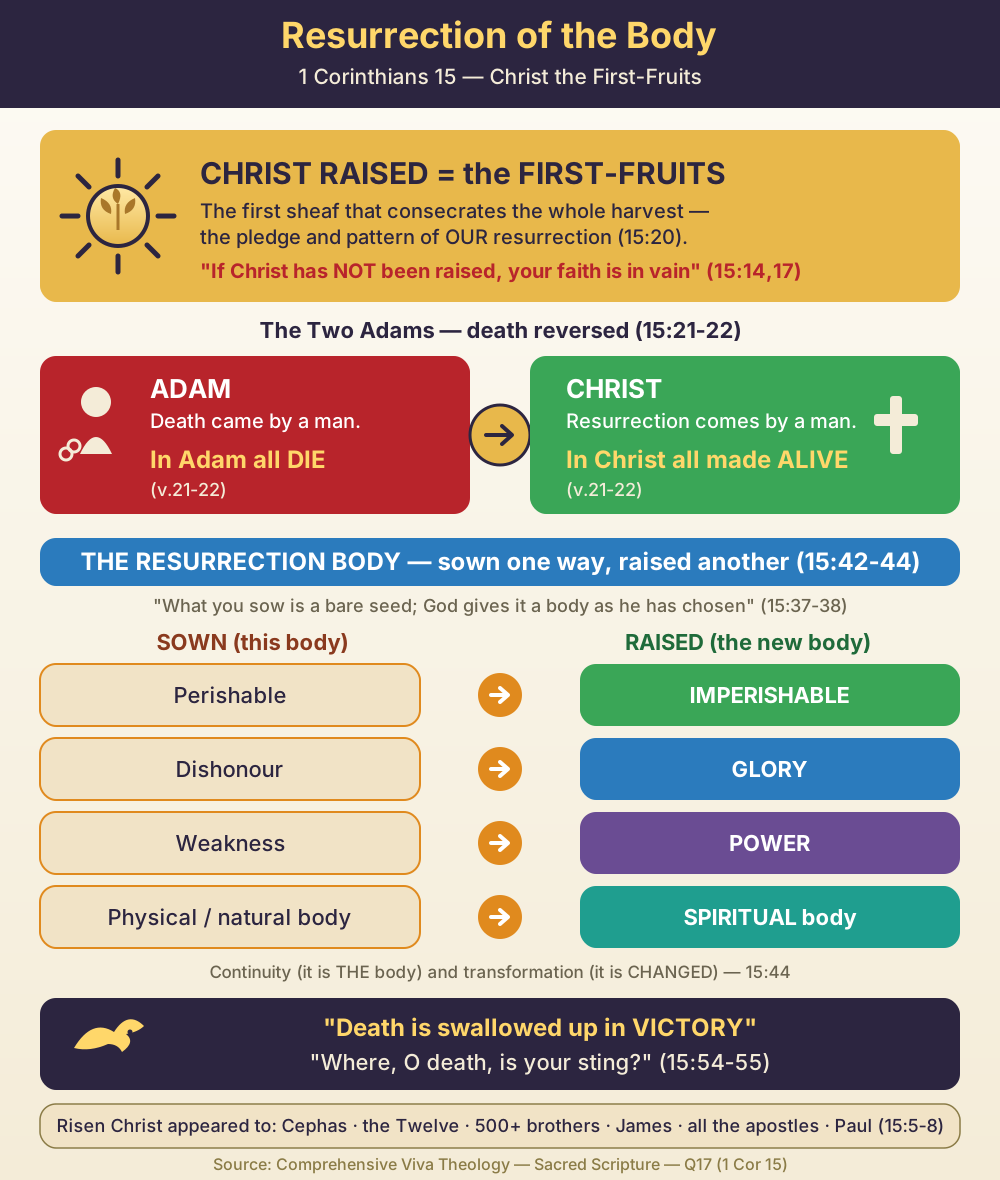
In short: Some Corinthians denied the resurrection of the dead, so Paul (chap. 15) first proves it from the appearances of the risen Christ, then shows that if Christ has not been raised everything collapses, presents Christ as the first-fruits who reverses Adam’s death, and finally explains the nature of the risen body — sown perishable, raised imperishable; a spiritual body.
Context. Some Corinthians rejected faith in the resurrection (15:12) — recall that the Sadducees denied resurrection while the Pharisees accepted it (Acts 23:8). Their real question was: what kind of body will the dead have? Paul writes to enlighten them on this mystery.
(1) Faith of the Church — two arguments (15:1-11). - Argument from appearance: the risen Jesus appeared to Cephas (15:5), to the Twelve (15:5 — possibly figurative; Mary/Matthias), to more than 500 brothers (15:6), to James and all the apostles (15:7), and finally to Paul himself (15:8). - Argument from baptism for the dead (15:29): the Corinthians had a custom of receiving baptism on behalf of dead relatives, believing the dead unbeliever could be saved through a living believer’s baptism. If the dead are not raised, the practice is absurd. Paul does not authorize this pagan cult — he merely uses it as an ad hominem argument for resurrection.
(2) “If Christ has not been raised…” — refuting the Corinthian position (15:12-19). Paul presses the logic: - If there is no resurrection of the dead, then Christ has not been raised. - If Christ has not been raised, then our proclamation is in vain and your faith is in vain. (And, by extension, we are still in our sins and are the most pitiable of all — the whole Gospel stands or falls on the resurrection.)
(3) Christ raised as first-fruits (15:20-28).
| Death side | Life side |
|---|---|
| Christ has been raised from the dead | He is the first-fruits of those who have died (v.20) — a symbolic expression, the first model of resurrection |
| Death came by a man (Adam) | The resurrection of the dead also comes by a man (Christ) (v.21) |
| In Adam all die | In Christ all shall be made alive (v.22) |
“First-fruits” (the first sheaf that guarantees and consecrates the whole harvest) means Christ’s resurrection is the pledge and pattern of ours.
(4) The resurrection body — transformation (15:35-58). - Analogy from nature (15:36-44a): what you sow is not the body that will be but a bare seed; “God gives it a body as he has chosen” (15:37-38). - Various kinds of body (15:39-41): human, animal, bird, fish, heavenly and earthly bodies — there are many kinds of “body.” - Paul’s application (15:42-44a): the four great contrasts —
| Sown (this body) | Raised (resurrection body) |
|---|---|
| Perishable | Imperishable |
| Dishonour | Glory |
| Weakness | Power |
| Physical body | Spiritual body |
So there is continuity (it is the body) and transformation (it is changed): “If there is a physical body, there is also a spiritual body.”
Key points: - Denial at Corinth (15:12); Sadducees denied, Pharisees accepted (Acts 23:8). - Appearances: Cephas, the Twelve, 500+, James, all the apostles, Paul (15:5-8). - Baptism for the dead (15:29) used as an argument, not endorsed. - “If Christ has not been raised, our preaching and your faith are in vain” (15:14). - Christ = first-fruits; Adam/Christ parallel — in Adam all die, in Christ all made alive (15:20-22). - Risen body: perishable→imperishable, dishonour→glory, weakness→power, physical→spiritual (15:42-44).
Connections: The Adam–Christ typology (in Adam all die, in Christ all live) is the same theology Paul develops in Romans 5 (the “two Adams”) and is central to Christology and soteriology. “Christ the first-fruits” grounds the Church’s faith that the believer’s resurrection follows the pattern of Christ’s. The “spiritual body” feeds the doctrine of the resurrection of the flesh in the Creed. The list of appearances (15:3-8) is the earliest credal formula of the death-burial-resurrection kerygma.
Q18 — The major theology in Romans (sin and the law, justification by faith, life in the Spirit, Israel, the Christian life)
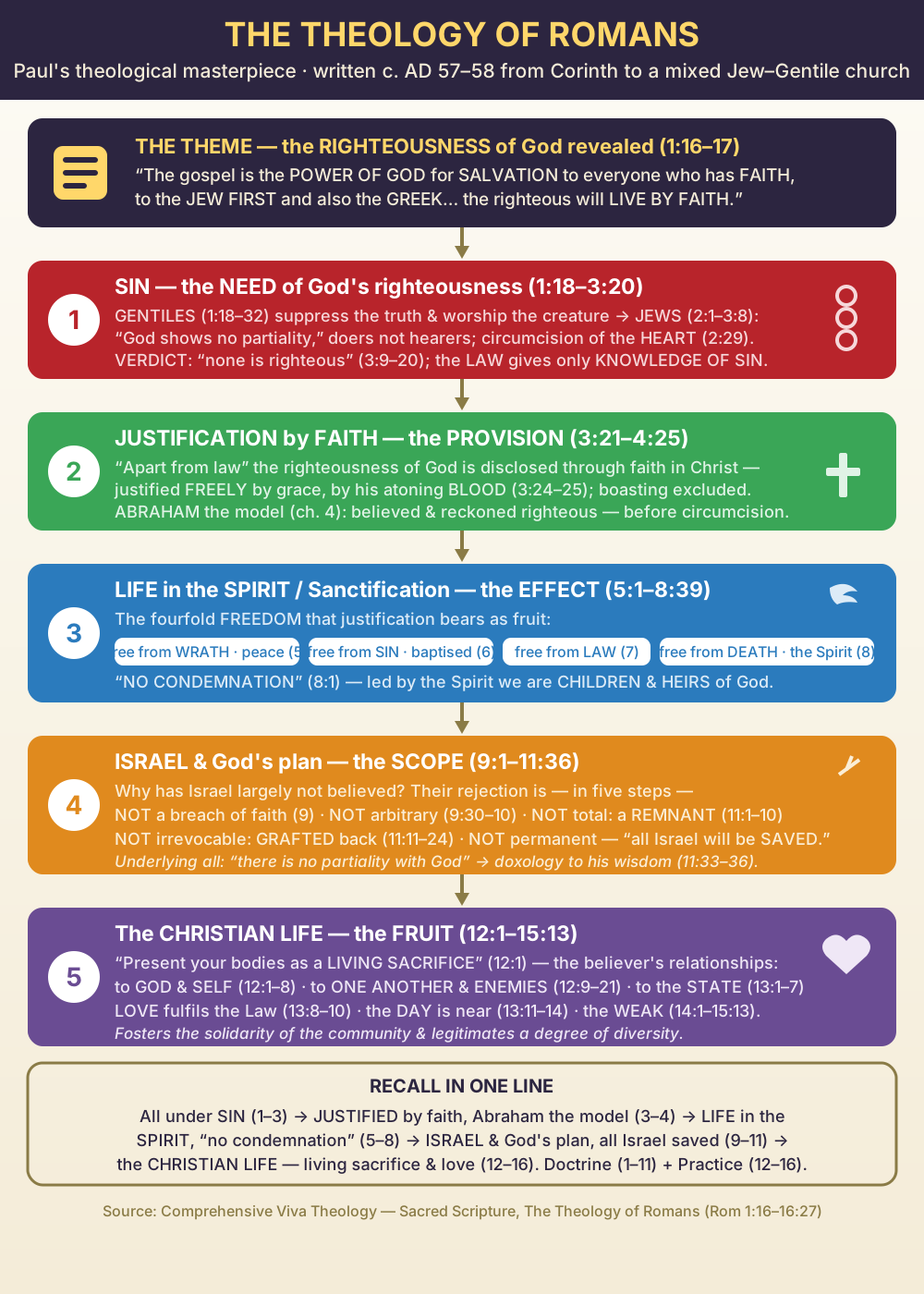
In short: Romans is Paul’s theological masterpiece (written c. AD 57-58 from Corinth to a mixed Jewish-Gentile church). Its one great theme is “the gospel is the power of God for salvation to everyone who has faith” (1:16-17): all — Gentile and Jew — are under sin and the Law cannot save; God therefore justifies freely by grace through faith in Christ; this justification bears fruit in sanctification and life in the Spirit; God’s plan even embraces Israel’s present unbelief and final salvation; and it issues in the practical Christian life of chapters 12–15.
Setting. Paul had never been to Rome (nor any apostle); the church was old, mixed, and Gentile-majority [the note adds that Claudius expelled the Jews in AD 49, leaving a Gentile-led church; their return after AD 54 created Jew–Gentile tension over the Torah — supplemented]. Paul writes as a prelude to visiting Rome on the way to Spain (15:24,28), with a missionary, apologetic, pastoral and personal purpose. The book is “very didactic, like a theological treatise,” with a long introduction (17 verses) and a very personal conclusion (26 named persons), heavy use of the OT, and rich in terms like sin, wrath, death, law, righteousness, justification.
Theme verse (1:16-17): “For I am not ashamed of the gospel; it is the power of God for salvation to everyone who has faith, to the Jew first and also to the Greek. For in it the righteousness of God is revealed through faith for faith… ‘The one who is righteous will live by faith.’” The primary theme: justification is available only through obedient faith in Jesus Christ — “faith that obeys, obedience through faith” (note the inclusio: 1:5 + 16:26).
The structure and argument of Romans
| Part | Chapters | Theme | Argument |
|---|---|---|---|
| Introduction | 1:1-17 | The Gospel | Theme stated: righteousness of God by faith (1:16-17) |
| I. Sin — the need of God’s righteousness | 1:18–3:20 | All are under sin | Gentiles (1:18-32) → Jews (2:1–3:8) → Universal: “none is righteous” (3:9-20); the Law only gives knowledge of sin (3:20) |
| II. Justification — the provision of God’s righteousness | 3:21–4:25 | By faith, not works | Revealed in Christ’s Cross (3:21-26); defended (3:27-31); illustrated in Abraham (4:1-25) |
| III. Sanctification — the effect of God’s righteousness | 5:1–8:39 | Life in the Spirit | Free from Wrath (5), from Sin (6), from Law (7), from Death/life in the Spirit (8) |
| IV. Israel — the scope of God’s righteousness | 9:1–11:36 | Jew & Gentile | Israel’s rejection is not a breach of faith (9:1-29), not arbitrary (9:30–10:21), not total (11:1-10), not irrevocable (11:11-24), not permanent (11:25-36) |
| V. Service — the fruit of God’s righteousness | 12:1–15:13 | The Christian life | Relationships to God, self, one another, enemies, the State, the Law, the Day, the weak |
| Conclusion | 15:14–16:27 | Paul’s ministry | Apostolic service, travel plans, greetings, doxology |
1. Sin and the Law (1:18–3:20)
- Gentiles (1:18-32): “ungodliness and wickedness”; they suppress the truth. Though creation reveals the Creator, they refused to honour or thank God, worshipping the creature instead of the Creator — idolatry. Its fruit is moral corruption (degrading passions, unnatural intercourse, a long vice-list).
- Jews (2:1–3:8): “God shows no partiality” (2:11) — he repays each according to deeds (2:6-10). Mere possessing the Law does not justify: “it is not the hearers but the doers of the Law who will be justified” (2:13). Circumcision profits only with obedience; real circumcision is of the heart, spiritual not literal (2:29; cf. Deut 30:6). Neither the Torah, nor circumcision, nor the promise will save the Jews.
- Universal verdict (3:9-20): “There is no one righteous, not even one… all have turned aside” — all, Jew and Greek, are under the power of sin. The Law cannot justify; “through the law comes the knowledge of sin” (3:20).
2. Justification by Faith (3:21–4:25)
- God’s saving justice to all (3:21-31): “Now, apart from law, the righteousness of God has been disclosed… through faith in Jesus Christ for all who believe, for there is no distinction” (3:21-22). All have sinned (3:23) and are “justified by his grace as a gift, through the redemption that is in Christ Jesus, whom God put forward as a sacrifice of atonement by his blood” (3:24-25). Boasting is excluded (3:27); a person is “justified by faith apart from works of the Law” (3:28); God is God of Jews and Gentiles, justifying both by faith (3:29-30).
- Abraham, the model (4:1-25): Abraham was justified by faith (4:1-8: “Abraham believed God and it was reckoned to him as righteousness,” Gen 15:6), before circumcision (4:9-12 — so he is father of believing Gentiles too), not by obedience to the Law (4:13-17 — the promise came through the righteousness of faith), and his faith is “a model of Christian faith” (4:18-25). Thus justification is by grace through faith, not earned by good deeds.
3. Life in the Spirit / Sanctification (5:1–8:39)
Justification’s effect is the new life, set out as a fourfold freedom: - Free from wrath (5): justified by faith we have peace with God through Christ; the Adam–Christ contrast (death through one man, grace and life through the One Man) [supplemented]. - Free from sin (6): baptized into Christ’s death and risen with him, we must no longer live in sin — “dead to sin, alive to God” [supplemented]. - Free from the Law (7): the believer is released from the Law; the Law is holy but reveals and stirs up sin — the cry “who will deliver me?” [supplemented]. - Free from death — the Spirit (8): “no condemnation for those in Christ Jesus”; those led by the Spirit are children of God and heirs with Christ, and nothing can separate us from the love of God [chap. 8 is the climax of “life in the Spirit”; the note gives the chapter heading “Free from Death (8:1-39)” — the detail is supplemented].
4. Israel (9:1–11:36)
Paul wrestles with why his own people have largely not believed. His answer, in five steps, is that Israel’s rejection is: 1. not a breach of faith (9:1-29) — God’s word has not failed; the true Israel is by promise, not flesh; 2. not arbitrary (9:30–10:21) — Israel stumbled by seeking righteousness through works, not faith; 3. not total (11:1-10) — a faithful remnant remains; 4. not irrevocable (11:11-24) — Gentiles are grafted in, Israel can be grafted back; 5. not permanent (11:25-36) — “all Israel will be saved”; ending in a doxology to God’s unsearchable wisdom. Underlying it all: “there is no partiality with God”, and God’s saving justice is offered to all through faith.
5. The Christian Life (12:1–15:13)
The ethical section (Rom 12–15) opens with “I appeal (parakaleo) to you… to present your bodies as a living sacrifice” (12:1). These chapters aim to foster the solidarity of the community, legitimate a degree of diversity in convictions and practices, and advise relations with outsiders, especially the State. It maps the believer’s relationships:
| Sphere | Text |
|---|---|
| To God | 12:1-2 |
| To ourselves | 12:3-8 (gifts) |
| To one another | 12:9-16 |
| To our enemies | 12:17-21 |
| To the State | 13:1-7 |
| To the Law | 13:8-10 (love fulfils the Law) |
| To the Day | 13:11-14 |
| To the weak | 14:1–15:13 |
Key points: - One theme: the Gospel is God’s saving power by faith for Jew and Greek (1:16-17). - Doctrinal (1–11) + Practical (12–16); “how to be just” + “how to live by faith.” - All under sin (1:18–3:20); the Law only reveals sin (3:20). - Justified freely by grace through faith in Christ’s atoning blood (3:21-26); Abraham the model (chap. 4). - Sanctification = freedom from wrath, sin, law, death — life in the Spirit (5–8). - Israel’s rejection is not total, not permanent — “all Israel will be saved” (9–11). - Christian life = “living sacrifice” and right relationships (12–15).
Connections: Justification by faith became the centre of the Reformation (Luther) yet remains core to all Christian traditions; the Catholic balance pairs it with Paul’s “faith working through love” (Gal 5:6) and James’ “faith without works is dead” — the note’s four-fold scheme: salvation by faith (Paul), by grace (Peter/Paul, Acts 15:11), by works of charity (James). The Adam–Christ typology (Rom 5) is the same theology as 1 Cor 15 (Christ the first-fruits). “Life in the Spirit” (Rom 8) ties to pneumatology and to baptismal theology (Rom 6, dying and rising with Christ). “Real circumcision of the heart” (2:29) connects to Gal 5:6 and the East-Syriac emphasis on interior faith over external observance.
Q19 — Key subjects of the Letter to the Hebrews: Jesus superior to Angels and to Moses; Priesthood (Melchizedek); Covenant and Sacrifice; Faith (Heb 11)
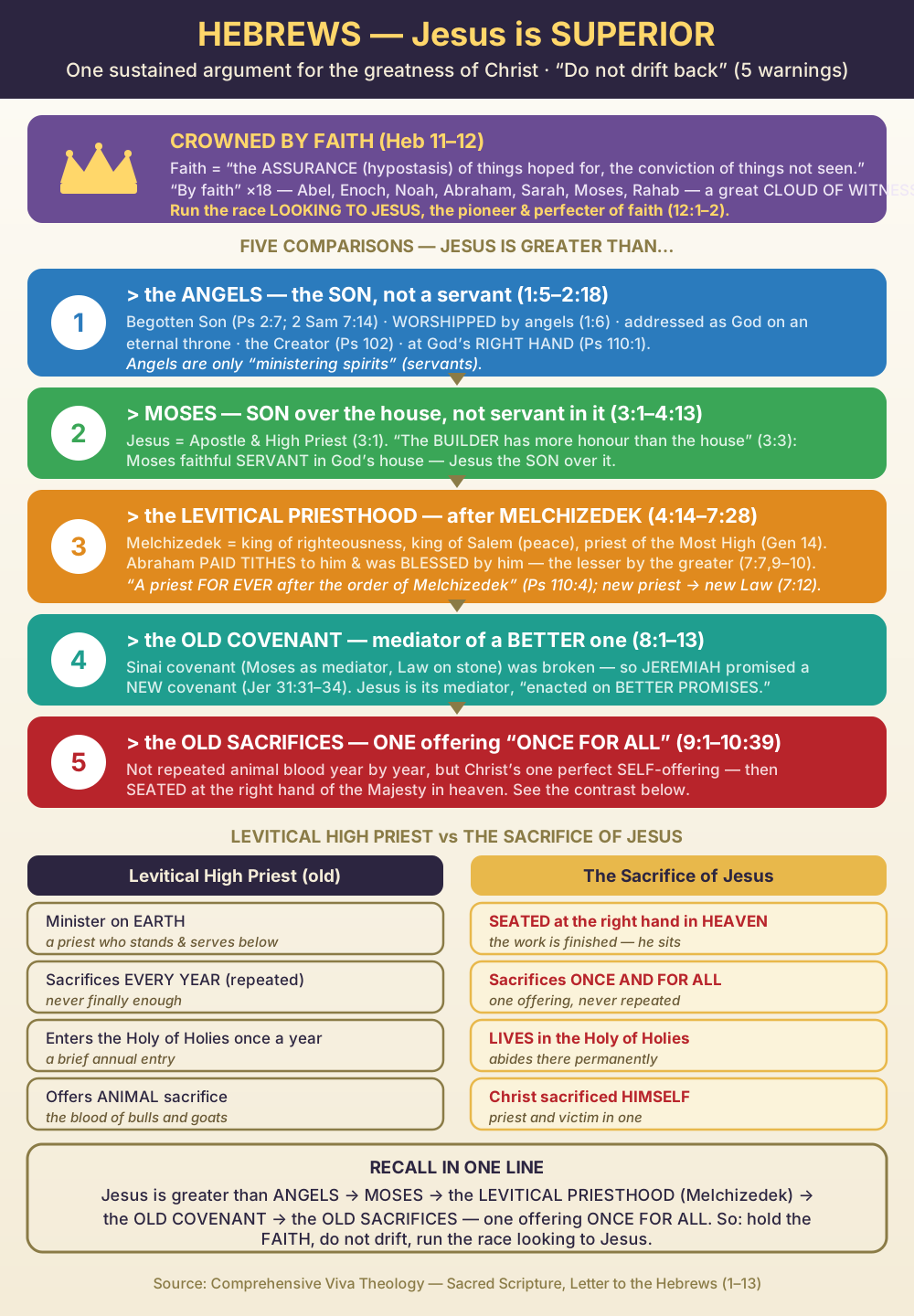
In short: Hebrews is one sustained argument for the superiority (greatness) of Jesus Christ, organised around five comparisons — Jesus is greater than the Angels, than Moses, his priesthood (after Melchizedek) is greater than the Levitical, his covenant and sacrifice are greater than the old, and chapter 11 crowns it with the great roll-call of faith. The whole letter is written to keep a tired, persecuted community from drifting back to Judaism (the danger of apostasy), so each “superiority” is also a reason to persevere.
Structure of Hebrews: Introduction (1:1–4) → Jesus superior to Angels (1:5–2:18) → Jesus greater than Moses (3:1–4:13) → Jesus the High Priest greater than the Levitical (4:14–7:28) → Mediator of a New Covenant / better sacrifice (8:1–10:39) → Faith and Suffering (11:1–12:29) → Life of the faithful (13:1–19) → Blessing & greetings (13:20–25). Five warning passages (2:1–4; 3:7–4:13; 5:11–6:12; 10:19–39; 12:14–29) thread through it, warning against slow spiritual drift and apostasy.
1. Greater than the Angels (1:5–2:18). Using a chain of OT texts, the author shows the Son holds a status angels never do: he is begotten Son (Ps 2:7; 2 Sam 7:14), worshipped by the angels (Heb 1:6; proskyneō = to fall down and worship), addressed as God with an eternal throne (Ps 45/89), is the unchanging Creator (Ps 102), and sits at God’s right hand (Ps 110:1) — while angels are mere “ministering spirits” (servants). The first warning follows at once: if the word given through angels was binding, how much more the salvation spoken by the Son (2:1–4).
2. Greater than Moses (3:1–4:13). Jesus is given the titles Apostle (apostolos) and High Priest (archiereus). Both Moses and Jesus are “faithful,” but the builder of a house has more honour than the house (3:3): Moses was a faithful servant in God’s house, Jesus is the Son over it. Sonship implies inheritance, authority and identity with the Builder (God) that a servant can never claim.
3. The Priesthood of Jesus — after the order of Melchizedek (4:14–7:28). Melchizedek (“king of righteousness,” king of Salem = “peace,” priest of the Most High God, Gen 14 / Heb 7:1–2) appears “without beginning or end,” a type of an eternal priest. His greatness over the Levitical line is proved because Abraham paid him tithes (the lesser pays the greater) and Abraham was blessed by him (the lesser is blessed by the greater) — and Levi, still “in the loins of Abraham,” paid tithes in him (7:9–10). Because the Levitical priesthood could not bring perfection, a new priest “after the order of Melchizedek” (Ps 110:4) was needed; a change of priesthood means a change of the Law (7:12).
4. New Covenant and the Sacrifice of Jesus (8:1–10:39). The old covenant (made at Sinai through Moses as mediator, the Law on stone tablets) was broken, so Jeremiah already promised a better covenant (Jer 31:31–34). Jesus is the mediator of this better covenant, enacted on better promises. His sacrifice surpasses the Levitical at every point.
5. Faith (Heb 11). Faith is “the assurance (hypostasis) of things hoped for, the conviction (elenchos) of things not seen.” The author makes the abstract concrete through OT “heroes of faith” — Abel, Enoch, Noah, Abraham (who obeyed and offered Isaac), Sarah, Moses, Rahab, the judges and prophets — the phrase “by faith” recurring 18 times — so that a community with so many examples must hold genuine faith in Jesus. Chapter 12 then frames the Christian life as a race run “looking to Jesus,” with trials understood as a Father’s loving discipline.
Table of the “superiority” arguments:
| Jesus is superior to… | Text | Core argument | Key proof / verse |
|---|---|---|---|
| Angels | 1:5–2:18 | Son, not servant; worshipped, divine, Creator, enthroned | Ps 2:7; 2 Sam 7:14; “let all God’s angels worship him” (1:6); Ps 110:1 (right hand); angels = “ministering spirits” |
| Moses | 3:1–4:13 | Builder > house; Son > servant | Jesus = Apostle & High Priest (3:1); “the builder has more honour than the house” (3:3); Moses faithful in the house, Jesus Son over it |
| Levitical Priesthood (Melchizedek) | 4:14–7:28 | A higher, eternal, oath-sworn priesthood | Abraham paid tithes to & was blessed by Melchizedek (Heb 7:7,9-10); “priest forever after the order of Melchizedek” (Ps 110:4); sinless, eternal (7:24-27) |
| Old Covenant | 8:1–13 | Mediator of a better covenant on better promises | Sinai covenant broken; Jeremiah’s new covenant (Jer 31:31-34) |
| Old Sacrifices | 9:1–10:39 | One perfect self-offering vs. repeated animal blood | see table below |
| (crowned by) Faith | 11:1–12:29 | Faith made concrete in the OT witnesses; persevere | “by faith” x18; Abraham, Moses, Rahab; run the race looking to Jesus (12:1-2) |
Levitical High Priest vs. Sacrifice of Jesus:
| Levitical High Priest | Sacrifice of Jesus |
|---|---|
| Minister on earth | Seated at the right hand of the Majesty in heaven |
| Sacrifices every year | Sacrifices once and for all |
| Enters the Holy of Holies once a year | Lives in the Holy of Holies |
| Offers animal sacrifice | Christ sacrificed Himself |
Connections: Hebrews supplies the New Testament’s richest priestly Christology — Christ as eternal High Priest — which underlies every Eucharistic theology and the doctrine of Christ’s one all-sufficient sacrifice (cf. Trent). The Melchizedek figure (king-priest, “bread and wine,” Gen 14) is read by the Fathers and the liturgy as a type of the Eucharist. The “great cloud of witnesses” (Heb 12:1) grounds the Catholic veneration of the saints, and the East Syriac Anaphora language of the heavenly altar and the once-for-all offering echoes Hebrews directly.
Q20 — Main concerns of the Book of Revelation
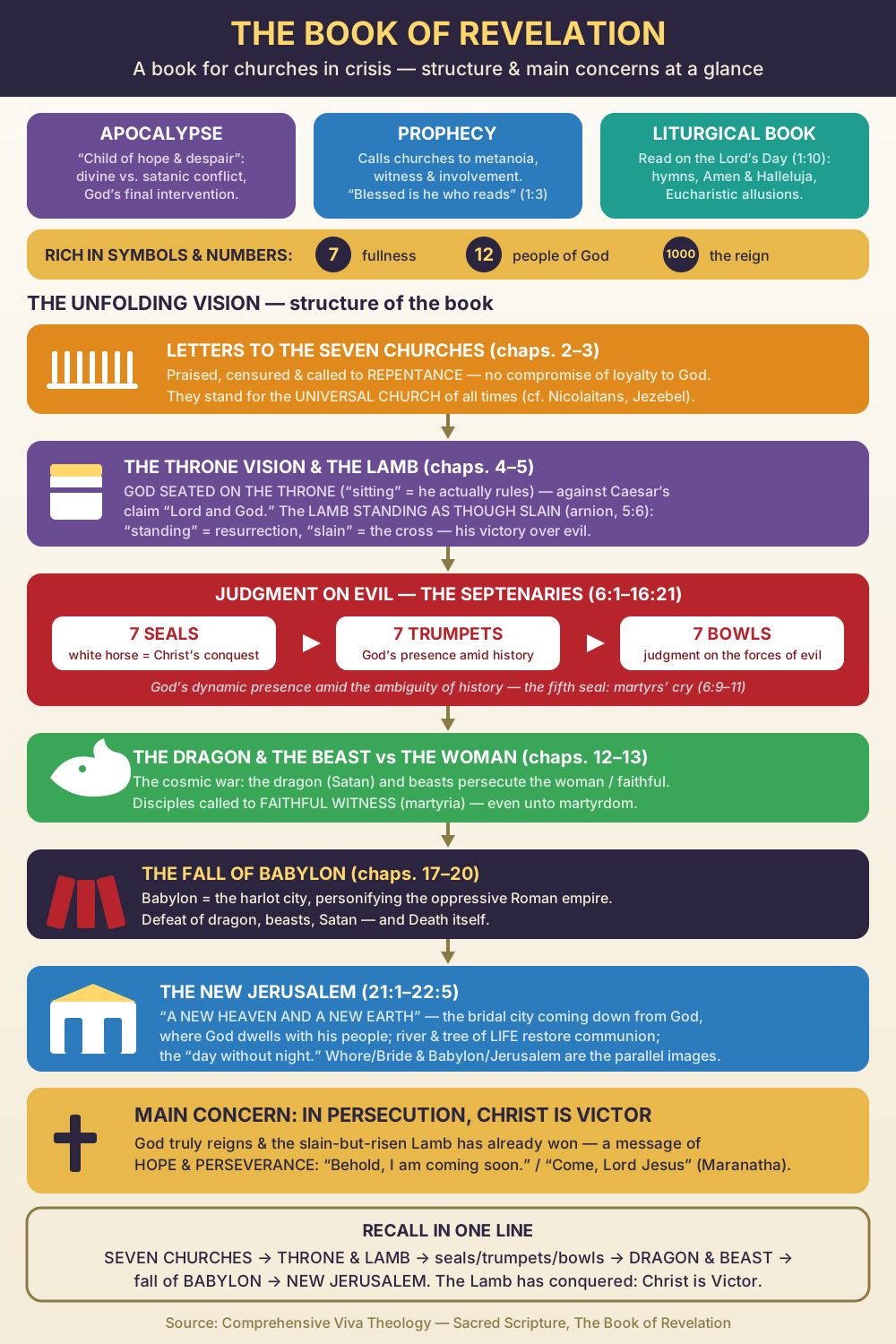
In short: Revelation is a book written for churches in crisis, assuring them that — despite emperor-cult, persecution and the apparent triumph of evil — God truly reigns and the slain-but-risen Lamb has already won the decisive victory, which will be consummated in the New Jerusalem. Its concerns are therefore Christological, pastoral, liturgical and eschatological all at once.
The book is at the same time an apocalypse, a prophecy and a liturgical book. As an apocalypse it is “a child of hope and despair” (Norman Perrin): born in (real or perceived) crisis, it depicts the conflict between the divine and satanic realms and the conviction that God will intervene to change history “utterly and forever.” As prophecy (it calls itself prophecy, 1:3; 22:18–19) it aims at metanoia — to bring the churches back to God, strengthen them and give hope in tribulation, urging them to involve themselves in history by witnessing to Christ. As a liturgical book it is meant to be read in the worshipping assembly on “the Lord’s Day” (kyriakē hēmera, 1:10), is studded with hymns, the Amen and Halleluja, Eucharistic allusions and heavenly worship scenes, so the community “experiences the future already in the present.”
The main concerns, drawn from the notes:
God reigns / divine sovereignty. The throne-room vision (chaps. 4–5) shows God seated on the throne (the present participle “sitting” stressing that God actually rules the world) — directly against the Roman emperor who claims to be “Lord and God.” The whole drama transforms “the kingdom of the world” into “the kingdom of the Lord and his Christ” (11:15).
Christology — the slain, victorious Lamb. The book is “basically Christological”: its very content is “the Revelation of Jesus Christ” (1:1). The turning point is the Lamb standing as though slain (arnion, 5:6) — “standing” = resurrection, “slain” = crucifixion. The Lamb’s death and resurrection are his victory over the powers of evil, which the book then traces being realised in history. The first rider on the white horse (6:2) signifies Christ’s conquering power.
Faithful witness, even to martyrdom (martyria). “Witness” is a key concept: Jesus is the faithful witness whose witness was sealed on the cross, and the disciple is called to remain faithful “even unto martyrdom” (cf. the cry of the martyred souls under the altar, the fifth seal, 6:9–11).
Call to conversion and no compromise. The seven churches (chaps. 2–3) are scrutinised, praised, censured and called to repentance — facing problems from outside (persecution, hostility from pagan and Jewish neighbours, provincial authorities) and from inside (competing prophetic groups like the Nicolaitans/Jezebel, lethargy, accommodation). “There is no question of compromise to one’s loyalty to God.” These churches stand for the universal church of all times.
Judgment on evil — the septenaries. The unfolding of the seals, trumpets and bowls (6:1–16:21) portrays God’s dynamic presence amid the ambiguity of history and his judgment on the forces of evil — culminating in the fall of Babylon (the harlot city, personifying the oppressive Roman empire) and the defeat of dragon, beasts, Satan, and Death itself (chaps. 17–20).
Salvation — the New Jerusalem. The summit of the vision: the New Jerusalem, the bridal city coming down from God (21:1–22:5), where God dwells with his people, the river and tree of life restore communion, and there is the “day without night.” Babylon/Jerusalem and whore/bride are the parallel images of judgment and salvation.
Hope and consolation. The essential apocalyptic message is the ultimate victory of God over evil and its total elimination; even if the faithful seem to fail in their fight, “God will definitively grant them everlasting victory.”
Genres of Revelation at a glance:
| Genre | What it contributes | Note marker |
|---|---|---|
| Apocalypse | Crisis-born; divine vs. satanic conflict; God’s final intervention; ultimate victory | Daniel & Revelation = the two canonical apocalypses |
| Prophecy | Calls churches to metanoia, witness, historical involvement | “blessed is he who reads… this prophecy” (1:3) |
| Liturgical book | Read on the Lord’s Day; hymns, Amen/Halleluja, Eucharistic allusions | begins & ends in liturgical dialogue (1,4-8; 22,20-21) |
Connections: Revelation’s “Lamb that was slain” feeds directly into Eucharistic and Christological theology (the Lamb of God of the liturgy); its “royal priesthood / holy nation” (Rev 1:6; 5:10) echoes 1 Peter 2:9 and grounds the priesthood of the baptised; and its eschatology — God’s day, New Jerusalem, “Come, Lord Jesus” (Maranatha) — is woven through Christian liturgy, including the Syro-Malabar/East Syriac expectation of the Kingdom. Note that Revelation was one of the books late or disputed in several canons (and absent from the original East Syriac canon [supplemented]), which the notes connect to its difficult symbolic genre.
Q21 — Major themes of the Acts of the Apostles: Acts 1:8 (programmatic), 2:42 (community life), the Deacons, Stephen, Acts 15 (Circumcision / Council of Jerusalem), and Paul’s journeys
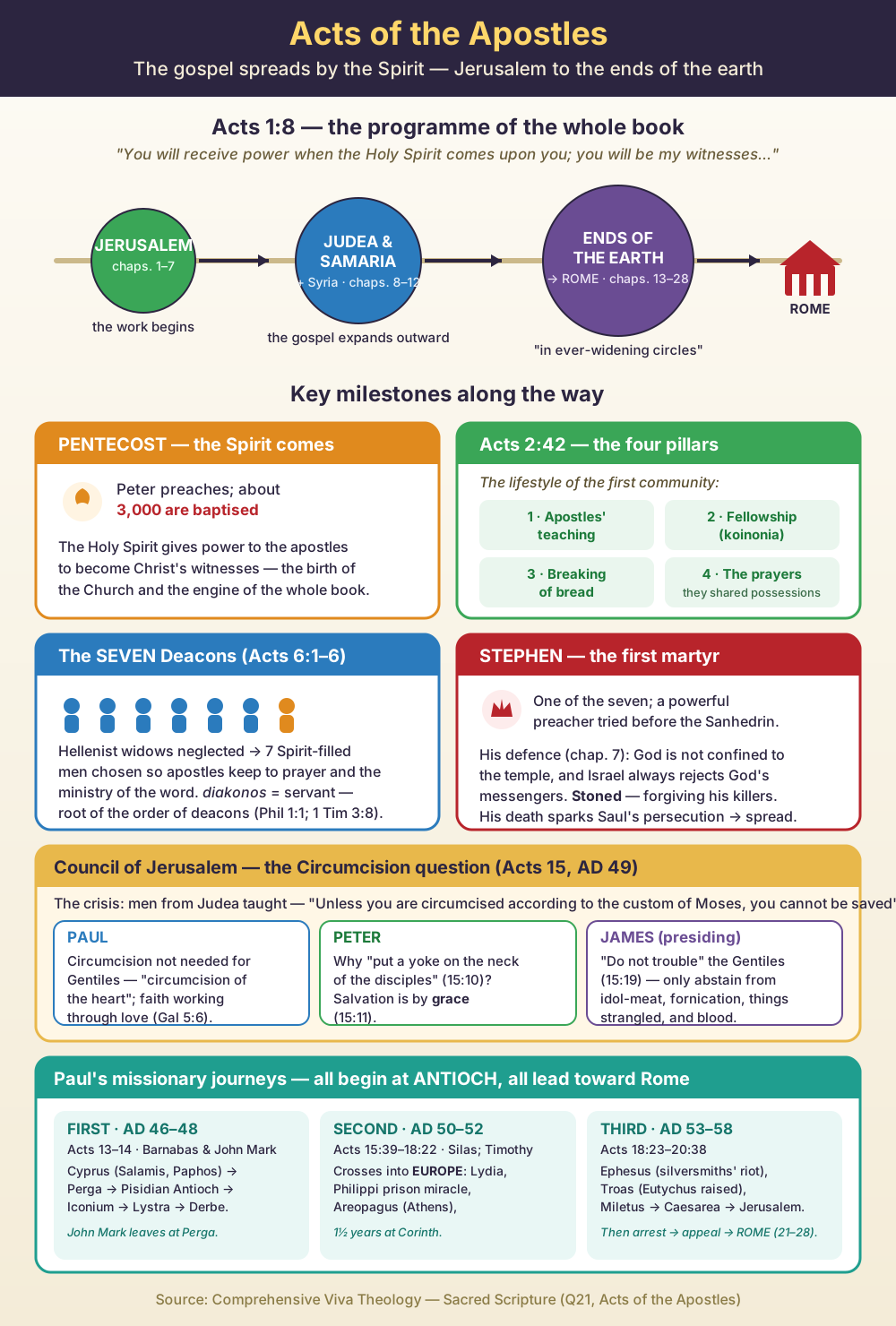
In short: Acts is Luke’s account of how the risen Christ, through the Holy Spirit, drove the gospel out from Jerusalem to the ends of the earth — the programme is stated in Acts 1:8, the life of the first community in 2:42, its organisation in the appointing of the Deacons and the martyrdom of Stephen, its first great crisis in the Council of Jerusalem (Acts 15), and its expansion in Paul’s missionary journeys.
Acts 1:8 — the programmatic verse. Jesus tells the apostles: “you will receive power when the Holy Spirit comes upon you; and you will be my witnesses in Jerusalem, in all Judea and Samaria, and to the ends of the earth.” This is the table of contents of the whole book: the work starts in Jerusalem (chaps. 1–7), expands through Judea, Samaria and Syria (chaps. 8–12), and keeps moving out until it reaches Rome, the heart of the Empire (chaps. 13–28). The gospel spreads “in ever-widening circles.”
Acts 2:42 — the life of the community. After Peter’s Pentecost sermon and the baptism of about three thousand, the new believers were built up through four pillars (2:42): “they devoted themselves to (1) the apostles’ teaching, (2) the fellowship (koinōnia), (3) the breaking of bread, and (4) the prayers.” The community had such unity that they pooled their possessions for the needy (2:43–47).
The Deacons (Acts 6:1–6). A tension arose between the Aramaic-speaking Jews and the Greek-speaking Hellenists, whose widows were being neglected in the daily distribution. The apostles had the church choose seven Spirit-filled men (their Greek names suggest they were Hellenists) so the apostles could give themselves to prayer and the ministry of the word (6:4). The Greek word diakonos = servant/minister; from this the order of deacons became a regular feature of the early Church (Phil 1:1; 1 Tim 3:8). Two of the seven (Stephen, Philip) were also gifted preachers — so the deacon’s work was never limited to material tasks.
Stephen (Acts 6:7–8:3). Stephen, one of the seven, was a powerful preacher who saw that Christianity and Judaism could not go hand in hand — with Christ’s death and resurrection, the Jewish system (Law, temple, priesthood) had fulfilled its purpose. Accused before the Sanhedrin, his defence (chap. 7) made two points from Israel’s history: (a) God is not confined to one place (so the temple is over-valued), and (b) Israel always rejected God’s messengers (so rejecting the Messiah is no surprise). He affirmed Christ’s equality with God, was dragged out and stoned — the first Christian martyr — dying like Jesus, committing his spirit to God and forgiving his killers. His death triggered fierce persecution led by the Pharisee Saul, scattering the Hellenist Christians (who then spread the gospel).
Acts 15 — the Circumcision question / Council of Jerusalem (AD 49). The crisis: men from Judea taught, “Unless you are circumcised according to the custom of Moses, you cannot be saved” (15:1). The Council settled it: - Paul: for Gentile Christians, circumcision is not needed for salvation (he urges “circumcision of the heart,” Rom 2:29; Deut 30:6; “faith working through love,” Gal 5:6). - Peter: why “put a yoke on the neck of the disciples which neither our fathers nor we could bear?” (15:10) — salvation is by grace (15:11). - James (presiding): his judgment — “do not trouble those Gentiles who turn to God,” asking only that they abstain from things polluted by idols, from fornication, from what is strangled, and from blood (15:19–20).
This was the decisive moment that opened the Church to the Gentiles without the burden of the Law.
The journeys of Paul. All of Paul’s missionary journeys begin at Antioch (the first Gentile church and “jumping-off point” for mission).
| Journey | Date (per notes) | Acts | Companions | Route / key places |
|---|---|---|---|---|
| First | AD 46–48 | 13:1–14:28 | Barnabas, John Mark (who leaves at Perga) | Antioch → Salamis → Paphos (Cyprus) → Perga → Pisidian Antioch → Iconium → Lystra → Derbe |
| (Jerusalem Council) | AD 49 | Acts 15 | with Barnabas | The circumcision question settled at Jerusalem |
| Second | AD 50–52 | 15:39–18:22 | Silas (Silvanus); Timothy joins at Lystra | Into Europe — Lydia’s conversion, Philippi imprisonment & prison miracle, Areopagus speech (Athens), 1½ years at Corinth |
| Third | AD 53–58 | 18:23–20:38 | — | Ephesus (sons of Sceva; silversmiths’ riot), Troas (Eutychus raised), Miletus, Tyre, Ptolemais, Caesarea, Jerusalem |
(After the third journey: arrest in Jerusalem, trials before Felix, Festus and Agrippa, appeal to Caesar, the storm and Malta, and finally Rome — Acts 21–28.)
Connections: Acts is the historical frame for the whole Pauline corpus — the Council of Jerusalem (15) is the narrative counterpart to Galatians and to Paul’s doctrine of justification by faith apart from the Law (Romans). Stephen’s “God does not dwell in a temple made by hands” anticipates Hebrews’ argument that the old cult is superseded in Christ. The four marks of community life in Acts 2:42 (teaching, fellowship, breaking of bread, prayer) are the perennial template of the Church’s life and a model the notes elsewhere call “the lifestyle of the first Church.” The diaconate of Acts 6 is the scriptural root of the order of deacon — directly relevant to a candidate preparing for ordained ministry.
Q22 — Meaning of the Greek words
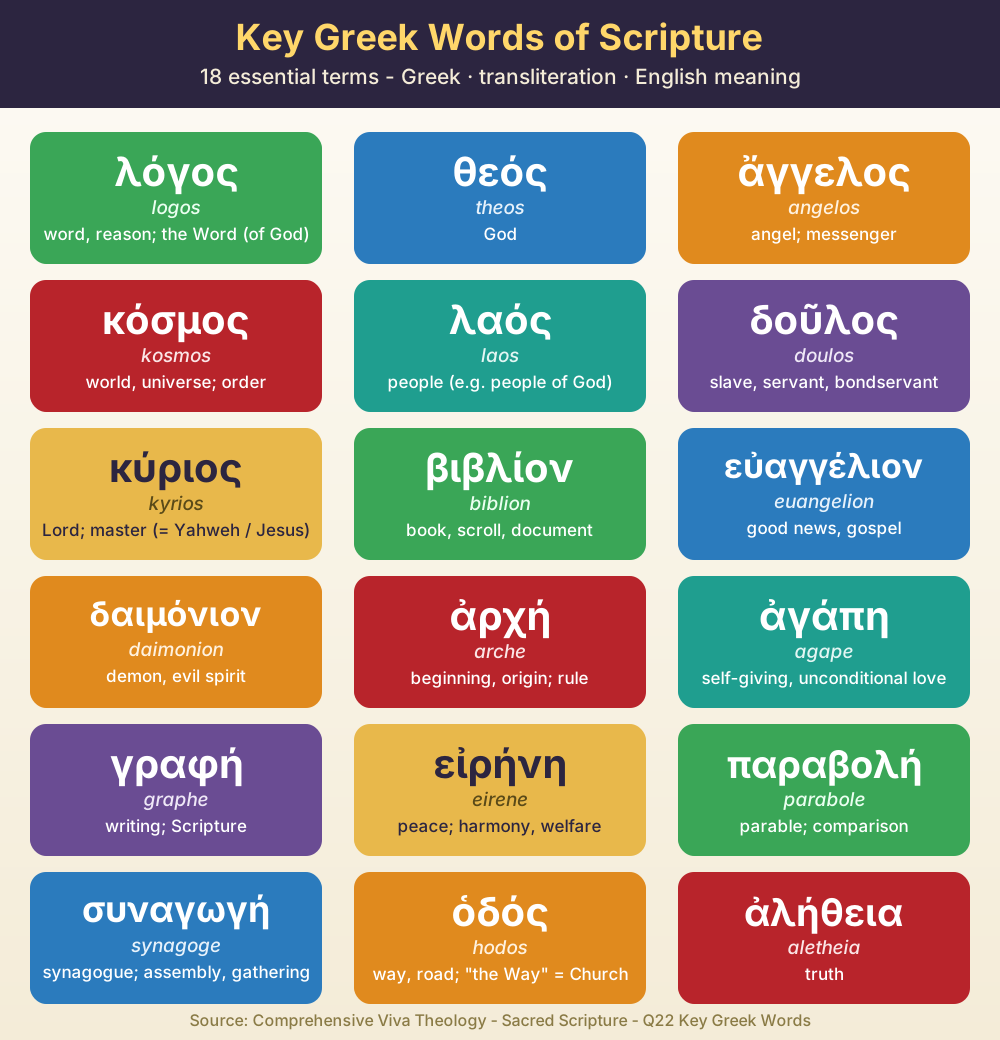
| Greek word (transliteration) | English meaning |
|---|---|
| λόγος (logos) | word, speech, reason; the Word (of God) |
| θεός (theos) | God |
| ἄγγελος (angelos) | angel; messenger |
| κόσμος (kosmos) | world, universe; order |
| λαός (laos) | people (a people, e.g. “people of God”) |
| δοῦλος (doulos) | slave, servant, bondservant |
| κύριος (kyrios) | Lord; master; (= Yahweh / the Lord Jesus) |
| βιβλίον (biblion) | book, scroll, document |
| εὐαγγέλιον (euangelion) | good news, gospel |
| δαιμόνιον (daimonion) | demon, evil spirit |
| ἀρχή (archē) | beginning; origin; rule, authority |
| ἀγάπη (agapē) | love (unconditional, self-giving love) |
| γραφή (graphē) | writing; Scripture |
| εἰρήνη (eirēnē) | peace; harmony, tranquillity, welfare |
| παραβολή (parabolē) | parable; comparison |
| συναγωγή (synagōgē) | synagogue; assembly, gathering |
| ὁδός (hodos) | way, road, path (also “the Way” = the Church) |
| ἀλήθεια (alētheia) | truth |